
Wilks Score Calculator: Compare Your Strength Across Any Bodyweight
Wilks Score Calculator
80 kg 30 kg200 kg 300 kg 20 kg600 kg Wilks Score 0.00 Relative Strength Coefficient Novice Compare Strength FairlyThe Wilks Score lets you compare raw powerlifting strength across different bodyweights and between lifters. Higher is better, regardless of how much you weigh.
View Training Plans #wilks-calc-widget input[type=range] { background: linear-gradient(to right, #f5e94e 0%, #f5e94e 0%, #333 0%, #333 100%); border: none; box-shadow: none; } #wilks-calc-widget input[type=range]::-webkit-slider-thumb { -webkit-appearance: none; width: 24px; height: 24px; border-radius: 50%; background: #ffffff; border: none; cursor: pointer; box-shadow: none; } #wilks-calc-widget input[type=range]::-moz-range-thumb { width: 24px; height: 24px; border-radius: 50%; background: #ffffff; border: none; cursor: pointer; box-shadow: none; } #wilks-calc-widget input[type=range]::-moz-range-track { background: transparent; border: none; box-shadow: none; } #wilks-calc-widget input[type=range]::-webkit-slider-runnable-track { border: none; box-shadow: none; background: transparent; } :root { --hx-bg-dark: #000000; /* Page background - Black */ --hx-card-bg: #111111; /* Card background - Dark Black */ --hx-card-border: #FFD400; /* Yellow border */ --hx-accent: #FFD400; /* Primary Yellow */ --hx-accent-light: #FFE44D; /* Light Yellow */ --hx-text-primary: #FFFFFF; /* White text */ --hx-text-secondary: #D6D6D6; /* Light Gray text */ --hx-radius: 14px; } .hx-calc-hub { background: var(--hx-bg-dark); padding: 64px 20px; font-family: 'Inter', 'Helvetica Neue', Arial, sans-serif; } .hx-calc-hub__inner { max-width: 1160px; margin: 0 auto; } .hx-calc-hub__eyebrow { display: block; text-align: center; color: var(--hx-accent); font-size: 13px; font-weight: 700; letter-spacing: 1.5px; text-transform: uppercase; margin-bottom: 12px; } .hx-calc-hub__title { text-align: center; color: var(--hx-text-primary); font-size: clamp(28px, 4vw, 40px); font-weight: 800; line-height: 1.15; margin: 0 0 14px; } .hx-calc-hub__subtitle { text-align: center; color: var(--hx-text-secondary); font-size: 16px; max-width: 620px; margin: 0 auto 48px; line-height: 1.6; } .hx-calc-grid { display: grid; grid-template-columns: repeat(4, 1fr); gap: 20px; } @media (max-width: 900px) { .hx-calc-grid { grid-template-columns: repeat(2, 1fr); } } @media (max-width: 540px) { .hx-calc-grid { grid-template-columns: 1fr; } } .hx-calc-card { display: flex; flex-direction: column; background: var(--hx-card-bg); border: 1px solid var(--hx-card-border); border-radius: var(--hx-radius); padding: 28px 22px; text-decoration: none; transition: transform 0.2s ease, border-color 0.2s ease, background 0.2s ease; } .hx-calc-card:hover { transform: translateY(-4px); border-color: var(--hx-accent); background: #000000; } .hx-calc-card__icon { width: 46px; height: 46px; border-radius: 10px; background: rgba(255, 90, 31, 0.12); display: flex; align-items: center; justify-content: center; margin-bottom: 18px; } .hx-calc-card__icon svg { width: 22px; height: 22px; stroke: var(--hx-accent); } .hx-calc-card__title { color: var(--hx-text-primary); font-size: 17px; font-weight: 700; margin: 0 0 8px; line-height: 1.3; } .hx-calc-card__desc { color: var(--hx-text-secondary); font-size: 13.5px; line-height: 1.55; margin: 0 0 20px; flex-grow: 1; } .hx-calc-card__cta { display: inline-flex; align-items: center; gap: 6px; color: var(--hx-accent-light); font-size: 13px; font-weight: 700; text-transform: uppercase; letter-spacing: 0.5px; } .hx-calc-card__cta svg { width: 14px; height: 14px; stroke: var(--hx-accent-light); transition: transform 0.2s ease; } .hx-calc-card:hover .hx-calc-card__cta svg { transform: translateX(4px); }Check for other Fitness calculators
Every metric you need to understand your body composition, energy needs, and true fitness potential — free, science-backed, and built for HYROX athletes.
Body Fat Percentage Calculator
Estimate your body fat using the U.S. Navy circumference method.
Calculate nowBMR Calculator
Find your basal metabolic rate — the calories your body burns at rest.
Calculate nowCalorie Calculator
Get your daily calorie needs for maintenance, fat loss, or muscle gain.
Calculate nowLean Body Mass Calculator
Find out how much of your weight is muscle, bone, and organ mass.
Calculate nowFFMI Calculator
Check your fat-free mass index and see your natural muscle potential.
Calculate nowIdeal Weight Calculator
Get your ideal weight range based on height, gender, and frame.
Calculate nowBody Recomposition Calculator
Plan your fat loss and muscle gain targets at the same time.
Calculate now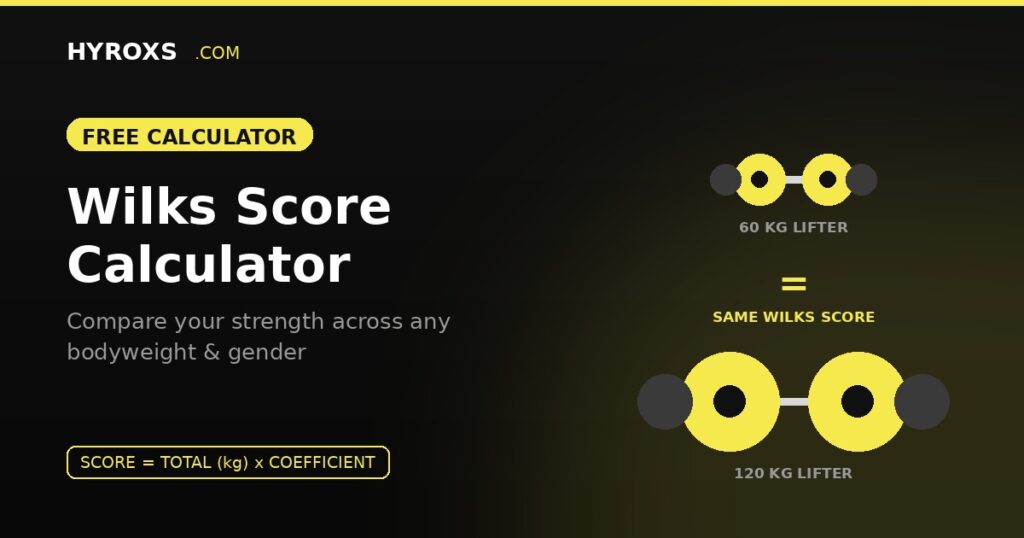
If you have ever wondered whether a 132-lb lifter totaling 900 lbs is actually stronger, pound for pound, than a 265-lb lifter totaling 1,700 lbs, you are asking exactly the question a Wilks score calculator was built to answer. Raw totals reward size. The Wilks score does not. It strips bodyweight out of the equation entirely and tells you how your strength stacks up against every other lifter on the planet, regardless of what the scale says.
A Wilks score calculator takes your bodyweight, gender, and total weight lifted, or your individual squat, bench press, and deadlift numbers, and converts them into a single standardized score using a polynomial formula built from decades of competition data. Below, we break down exactly how the Wilks system works, how it compares to newer scoring methods, what counts as a good score at every level, and how to actually raise your number, whether you are training for a meet or just want an honest read on your relative strength ahead of a HYROX season.
Wilks Score CalculatorWhat Is a Wilks Score Calculator?
A Wilks score calculator applies the Wilks Coefficient, a formula developed in the 1990s by Robert Wilks, then CEO of Powerlifting Australia, to standardize strength comparisons across different bodyweights. It provides a way to compare a 60kg lifter directly against a 120kg lifter on a level playing field, correcting for the natural strength advantage that comes with being heavier.
The system works by calculating a bodyweight-specific coefficient using a fifth-degree polynomial equation, with separate constants for men and women. That coefficient is then multiplied by your total lifted weight (squat plus bench press plus deadlift, in kilograms) to produce your final Wilks score. Because the formula was derived by analyzing thousands of powerlifting competition results, lighter lifters receive a higher coefficient, making their lifts count for proportionally more, while heavier lifters receive a lower coefficient, since raw size already gives them a strength advantage.
For decades, the Wilks score was the official scoring system of the International Powerlifting Federation, and even though it has since been succeeded by newer systems, it remains one of the most widely tracked strength benchmarks in gyms, local meets, and online leaderboards.
Wilks Score CalculatorThe Wilks Score Formula
A Wilks score calculator runs on the following formula:
Wilks Coefficient = 500 ÷ (a + b·BW + c·BW² + d·BW³ + e·BW⁴ + f·BW⁵)
Where BW is bodyweight in kilograms, and the constants a through f differ between men and women, each derived from statistical modeling of elite powerlifting performances.
Final Wilks Score = Total Lifted (kg) × Wilks Coefficient
In practice, you never need to solve this polynomial by hand. A Wilks score calculator does the math instantly, but understanding the structure matters: the formula was built directly from analyzing the mathematical relationship between bodyweight and strength potential across thousands of real competition results, which is why lighter lifters receive a coefficient that rewards their lifts more heavily, and heavier lifters receive a lower multiplier that accounts for the natural leverage and mass advantages of size.
Wilks Score CalculatorWilks vs. Modern Scoring Systems
If you have spent any time researching relative strength, you have likely run into more than one scoring system, and it helps to know how they differ before you rely on a Wilks score calculator for comparison.
- Wilks Score (original system): Still the most widely used score for historical tracking and gym leaderboards, even though it is no longer the official federation standard.
- IPF Points: Adopted by the International Powerlifting Federation as its official replacement system, built on more recent data with adjustments designed to better handle extreme bodyweights.
- DOTS Score: Developed more recently by the broader strength community, generally considered more accurate at the lightest and heaviest bodyweight extremes, where the original Wilks formula was known to skew slightly.
- Glossbrenner (GL Points): Used primarily in drug-tested federations, following a similar underlying approach to Wilks.
Each system produces a different raw number for the same lift total, so a Wilks score of 400 is not directly comparable to a DOTS score of 400. If you are tracking progress or comparing yourself to other lifters, stick to one system consistently, and be clear about which formula a Wilks score calculator is using before comparing results across different tools or leaderboards.
Wilks Score CalculatorWilks Score Standards: What Counts as a Good Score?
A Wilks score calculator becomes far more useful once you can measure your result against real benchmarks. While individual results vary with genetics, training history, and body composition, the following classifications are commonly used to gauge where a lifter sits relative to the broader powerlifting population.
Male Wilks Score Classifications
| Classification | Wilks Score | Description |
|---|---|---|
| Beginner | Under 250 | 0 to 6 months of training, learning proper form |
| Novice | 250 – 300 | 6 to 12 months training, consistent progression |
| Intermediate | 300 – 350 | 1 to 2 years training, first competition level |
| Advanced | 350 – 400 | 2 to 4 years training, regional competition level |
| Elite | 400 – 450 | 4+ years training, national competition level |
| World Class | 450 – 500 | International competition level |
| World Record | 500+ | Top 1 percent of all powerlifters globally |
Female Wilks Score Classifications
| Classification | Wilks Score | Description |
|---|---|---|
| Beginner | Under 200 | 0 to 6 months of training, learning proper form |
| Novice | 200 – 250 | 6 to 12 months training, consistent progression |
| Intermediate | 250 – 300 | 1 to 2 years training, first competition level |
| Advanced | 300 – 350 | 2 to 4 years training, regional competition level |
| Elite | 350 – 400 | 4+ years training, national competition level |
| World Class | 400 – 450 | International competition level |
| World Record | 450+ | Top 1 percent of all powerlifters globally |
Wilks Score Examples by Bodyweight
To see how the coefficient plays out in practice, here is what different totals translate to at various bodyweights, using a Wilks score calculator with example totals for context:
| Bodyweight | Total (kg) | Wilks Score | Level |
|---|---|---|---|
| 60 kg (132 lbs) | 400 kg | ~340 | Intermediate |
| 75 kg (165 lbs) | 500 kg | ~340 | Intermediate |
| 90 kg (198 lbs) | 600 kg | ~345 | Advanced |
| 105 kg (231 lbs) | 700 kg | ~390 | Elite |
| 120 kg (265 lbs) | 800 kg | ~420 | Elite |
Notice how lighter lifters need proportionally less total weight to reach the same Wilks score as heavier lifters, a direct reflection of pound-for-pound strength rather than absolute size.
Wilks Score by Training Age
Just like any strength metric, your realistic Wilks score depends heavily on how long you have been training consistently. General guidelines, drawn from typical progression patterns among natural lifters, look roughly like this:
- Year 1: Most beginners reach a 200 to 300 Wilks score (men) or 150 to 250 (women) with consistent training and proper programming.
- Years 2 to 3: Intermediate lifters typically achieve 300 to 375 Wilks (men) or 250 to 325 (women) as technique solidifies and strength base develops.
- Years 4 to 6: Advanced lifters may reach 375 to 425 Wilks (men) or 325 to 375 (women) with optimized training and competition experience.
- Years 7+: Elite lifters who have maximized their genetic potential may achieve 425 to 500+ Wilks (men) or 375 to 450+ (women).
These are general guidelines, not hard rules. Individual variation based on genetics, training quality, body composition, age, and dedication creates significant overlap between categories, so use a Wilks score calculator to track your own trajectory over time rather than fixating on a single benchmark number.
Wilks Score CalculatorWilks Score Records and Elite Performance
Understanding what elite lifters actually achieve provides useful context for setting your own goals. Historically, the highest Wilks scores ever recorded have come from lighter weight classes, since lighter lifters tend to produce the most favorable strength-to-weight ratios. Male world-record-level totals in the 60 to 85 kg range have produced Wilks scores in the 630 to 660 range, while elite female lifters in similarly light classes have posted scores in the 500 to 510 range. These numbers sit far above what any recreational lifter should expect, but they illustrate just how much headroom exists between "elite" and the absolute ceiling of the sport.
How to Improve Your Wilks Score
Improving your Wilks score comes down to increasing your total lifted weight across the squat, bench press, and deadlift, but there is a real strategy behind doing it efficiently.
Follow periodized training programs. Progressive periodization is essential for consistent strength gains. A typical structure cycles through a hypertrophy phase (4 to 6 weeks of 8 to 12 reps at 65 to 75 percent of 1RM to build a muscle mass foundation), a strength phase (4 to 6 weeks of 3 to 6 reps at 80 to 90 percent of 1RM), a peaking phase (2 to 3 weeks of 1 to 3 reps at 90 to 100 percent of 1RM), and a deload week at reduced volume to prevent overtraining. Popular programming templates such as 5/3/1, Sheiko, and the Calgary Barbell method are all built around this same periodized logic.
Prioritize your weakest lift. Since your Wilks score is calculated from your total, your weakest lift is what is holding your number back. A weak squat generally responds well to front squats, pause squats, and glute and quad accessory work alongside hip and ankle mobility. A weak bench often improves with higher pressing frequency, close-grip variations, and stronger upper back and leg drive. A weak deadlift typically benefits from deficit deadlifts, Romanian deadlifts, and posterior chain accessory work targeting the hamstrings, glutes, and spinal erectors.
Prioritize your weakest lift. Since your Wilks score is calculated from your total, your weakest lift is what is holding your number back. A weak squat generally responds well to front squats, pause squats, and glute and quad accessory work alongside hip and ankle mobility. A weak bench often improves with higher pressing frequency, close-grip variations, and stronger upper back and leg drive. A weak deadlift typically benefits from deficit deadlifts, Romanian deadlifts, and posterior chain accessory work targeting the hamstrings, glutes, and spinal erectors.
Master technique and lifting economy. Efficient technique alone can add 10 to 30 kg to your total without any increase in raw strength. Small adjustments, optimal squat stance and depth consistency, proper bench arch and grip width, and correct deadlift starting position and bar path, translate directly into a higher number on a Wilks score calculator, even before you get stronger.
Optimize body composition strategically. Because your Wilks score factors in both bodyweight and total, body composition changes can move your number in either direction. Lean lifters who gain 2 to 5 kg of muscle while maintaining or slightly increasing strength will typically see their Wilks score improve, since the added total outweighs the small coefficient decrease. Lifters carrying excess body fat often see the opposite effect: cutting weight while maintaining strength increases the coefficient more than it decreases the total, improving the overall score.
Implement proper recovery. Strength is built during recovery, not just during training. Aim for 7 to 9 hours of sleep on a consistent schedule, eat at maintenance or a slight surplus with adequate protein around 0.8 to 1g per pound of bodyweight, manage chronic stress, and build in planned deload weeks every 4 to 6 weeks.
Use competition to drive progress. Competing provides motivation, pressure, and often brings out lifts that are difficult to replicate in a normal training session. Most serious lifters compete two to four times per year in local, regional, or national meets, and the adrenaline and atmosphere of competition frequently produces personal records that meaningfully boost a Wilks score.
Wilks Score Calculator https://youtu.be/LTxZo27oUoU?si=PeLdhb5iIWmcvbYG Wilks Score CalculatorCommon Mistakes When Calculating and Using Wilks Score
- Using gym lifts instead of competition-standard lifts. Wilks scores are meant to reflect strict, judged lifts. High squats that would not pass depth in competition, benches with a bounced or lifted-glute execution, and deadlifts with hitching can each inflate a lift by 10 to 30 kg. For an accurate Wilks score calculator result, use only competition-standard lifts or have your attempts filmed and judged against official federation rules.
- Comparing across different scoring formulas. A Wilks score of 400 is not equivalent to an IPF Points score of 400 or a DOTS score of 400. Always compare like for like.
- Ignoring bodyweight fluctuations. Your Wilks coefficient changes with bodyweight, so a lifter at 82 kg with a 600 kg total has a different score than the same lifter at 85 kg with the same total. Use your same-day competition bodyweight for the most accurate result.
- Setting unrealistic timeline expectations. Natural lifters typically need four to seven years of consistent training to reach Elite-level scores. Comparing a six-month total to someone else's five-year total creates unnecessary discouragement.
- Neglecting individual variation. Genetics significantly influence strength potential. Some lifters plateau around 350 Wilks despite years of dedicated training, while others reach 450+ in a similar timeframe. Use your own progress as the benchmark that matters most.
Training for Your First Powerlifting Competition
If you are working toward your first meet and want an accurate Wilks score baseline, structured preparation matters. A common 12-week peak cycle looks like this: weeks 1 through 4 build work capacity with 8 to 12 rep hypertrophy work, weeks 5 through 8 shift to a strength block of 3 to 6 reps at 80 to 87 percent of 1RM, weeks 9 through 11 focus on peaking with 1 to 3 reps at 88 to 95 percent, and week 12 is a deload down to 40 to 50 percent volume before competing.
Smart attempt selection also protects your total. A common approach is to open with a weight you can hit for three reps in training, roughly 90 to 92 percent of your max, to guarantee a successful lift, then add 5 to 10 kg for your second attempt based on how the opener felt, and reserve your third attempt for a genuine personal record, typically 2.5 to 7.5 kg above your training max, capitalizing on competition adrenaline.
Wilks Score CalculatorHow Nutrition Supports Your Wilks Score
Your training capacity, recovery, and ultimately your total lifted all depend on eating to support the work. Most competitive lifters gaining strength eat 200 to 500 calories above maintenance, aiming for gradual bodyweight increases of roughly 0.25 to 0.5 percent per week, while those cutting weight for a class typically stay 300 to 500 calories below maintenance for a controlled loss of 0.5 to 1 percent bodyweight per week. Protein intake in the range of 0.8 to 1g per pound of bodyweight supports recovery and helps prevent muscle loss during a cut, while adequate carbohydrate intake fuels the training intensity that actually drives strength adaptation. If you want to dial in your calorie targets before a training block, our fitness calculators hub includes a BMR and TDEE calculator you can use alongside your Wilks score calculator to plan a bulk or cut with more precision. Read a interesting podcast.
Wilks Score CalculatorFrequently asked questions (FAQs)
What is a good Wilks score for a beginner?
A Wilks score under 250 for men or under 200 for women is typical in the first six months of training, while most beginners reach 250 to 300 (men) or 200 to 250 (women) within their first year of consistent training.
Wilks Score CalculatorIs Wilks score still relevant today?
Yes. Even though the International Powerlifting Federation officially transitioned to IPF Points, the Wilks score remains widely used in powerlifting communities, local competitions, and training programs because of its decades of accumulated data and familiarity among lifters.
Wilks Score CalculatorWhat's the difference between Wilks and DOTS?
Both systems standardize strength across bodyweights using a similar polynomial approach, but DOTS was built on more recent competition data and is generally considered more accurate for lifters at the very light or very heavy ends of the bodyweight spectrum.
Wilks Score CalculatorHow long does it take to reach a 400 Wilks score?
For most natural male lifters, reaching 400 Wilks typically requires four or more years of consistent, well-programmed training, placing it at the boundary between the Advanced and Elite classifications.
Wilks Score CalculatorShould I gain or lose weight to improve my Wilks score?
It depends on your current body composition. Lean lifters generally improve their score by gaining muscle and total lifted weight, while lifters carrying excess body fat often see a bigger improvement from cutting weight while maintaining strength, since the coefficient increase outweighs the loss in total.
Wilks Score CalculatorA Wilks score under 250 for men or under 200 for women is typical in the first six months of training, while most beginners reach 250 to 300 (men) or 200 to 250 (women) within their first year of consistent training.
Wilks Score CalculatorYes. Even though the International Powerlifting Federation officially transitioned to IPF Points, the Wilks score remains widely used in powerlifting communities, local competitions, and training programs because of its decades of accumulated data and familiarity among lifters.
Wilks Score CalculatorBoth systems standardize strength across bodyweights using a similar polynomial approach, but DOTS was built on more recent competition data and is generally considered more accurate for lifters at the very light or very heavy ends of the bodyweight spectrum.
Wilks Score CalculatorFor most natural male lifters, reaching 400 Wilks typically requires four or more years of consistent, well-programmed training, placing it at the boundary between the Advanced and Elite classifications.
Wilks Score CalculatorIt depends on your current body composition. Lean lifters generally improve their score by gaining muscle and total lifted weight, while lifters carrying excess body fat often see a bigger improvement from cutting weight while maintaining strength, since the coefficient increase outweighs the loss in total.
Wilks Score Calculator