
Muscle Gain Calculator: How Much Muscle Can You Build?
MUSCLE GAIN CALCULATOR
Estimated Yearly Gain
Know Your Growth Ceiling
Your natural muscle-building potential has a genetic ceiling. Use it as the long-term target for your bulking phases, and pace your gains so you build muscle, not just body fat.
Check for other Fitness calculators
Every metric you need to understand your body composition, energy needs, and true fitness potential — free, science-backed, and built for HYROX athletes.
Body Fat Percentage Calculator
Estimate your body fat using the U.S. Navy circumference method.
Calculate nowBMI Calculator
Check your body mass index and see where you fall on the standard scale.
Calculate nowCalorie Calculator
Get your daily calorie needs for maintenance, fat loss, or muscle gain.
Calculate nowLean Body Mass Calculator
Find out how much of your weight is muscle, bone, and organ mass.
Calculate nowFFMI Calculator
Check your fat-free mass index and see your natural muscle potential.
Calculate nowIdeal Weight Calculator
Get your ideal weight range based on height, gender, and frame.
Calculate nowBody Recomposition Calculator
Plan your fat loss and muscle gain targets at the same time.
Calculate now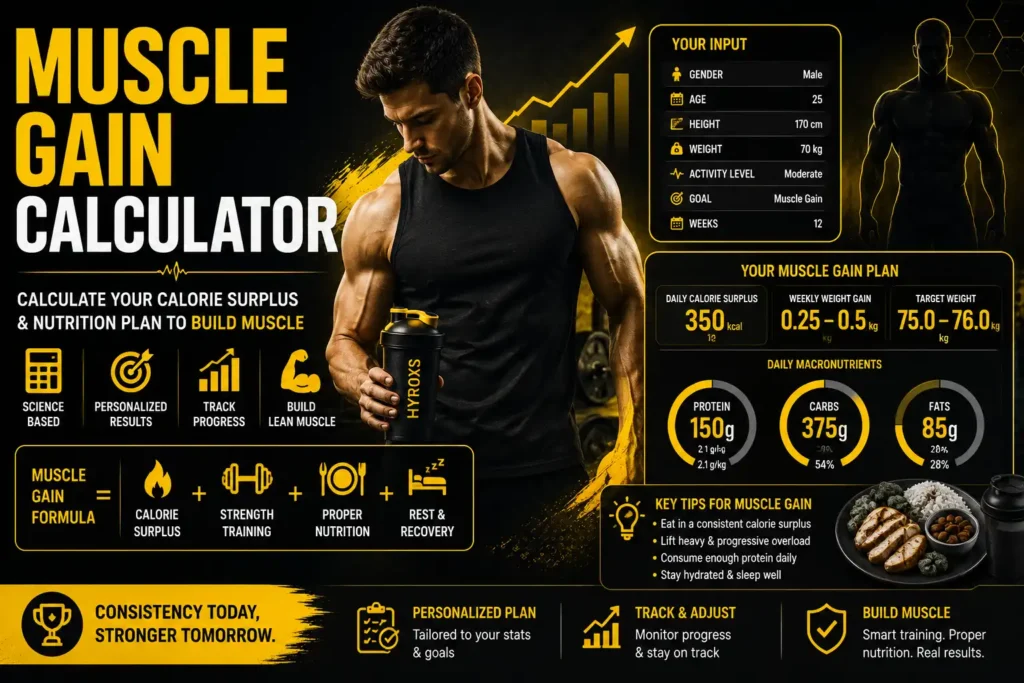
If you have ever wondered how much muscle you can actually gain in a month, a year, or over a lifetime of training, you are not alone. It is one of the most searched questions in strength training, and it is also one of the most misunderstood. Social media promises 20 pounds of muscle in eight weeks. Supplement ads promise even more. The truth, backed by decades of research on natural lifters, looks very different, and that is exactly why a muscle gain calculator exists.
A muscle gain calculator uses variables like training age, gender, body weight, and genetics to estimate a realistic rate of lean tissue growth, so you can set goals that actually match human physiology instead of marketing copy. Below, we break down the science behind muscle growth rates, the models researchers use to predict them, and how to use this information to plan smarter training and nutrition, including how it ties directly into HYROX-style hybrid training where strength-to-bodyweight ratio matters as much as raw size.
What Is a Muscle Gain Calculator and Why Does It Matter?
A muscle gain calculator is a tool that estimates how much lean muscle mass a person can realistically add over a given period, typically expressed as pounds or kilograms per month or per year. Instead of giving you one generic number, a good muscle gain calculator adjusts its estimate based on several personal factors:
- Training experience (beginner, intermediate, advanced, or elite)
- Gender, since testosterone levels heavily influence growth rate
- Age, because hormone production and recovery capacity decline over time
- Current body composition and genetic potential
- Nutrition and training quality
The reason this matters is simple: unrealistic expectations are one of the biggest reasons people quit strength training. When a beginner expects to gain two pounds of muscle a week and instead sees half a pound a month, it feels like failure, even though half a pound a month might be an excellent, on-track result for their stage. A muscle gain calculator resets the baseline so progress can be measured against biology, not Instagram transformations that are often assisted, over a longer timeframe, or simply not accurate.
The Science Behind Muscle Growth
Muscle growth, known scientifically as hypertrophy, happens when resistance training creates a stimulus that the body responds to by increasing the size and density of muscle fibers. Research published in strength and conditioning literature generally points to three mechanisms driving this process:
- Mechanical tension — heavy or challenging resistance placed on a muscle signals it to adapt and grow stronger.
- Metabolic stress — the buildup of metabolites during higher-rep training contributes to the growth response, often described as “the pump.”
- Muscle damage — small, controlled tears in muscle fibers are repaired and rebuilt slightly larger through a process called muscle protein synthesis.
For this repair process to actually produce new tissue, several conditions have to be met at the same time: sufficient dietary protein (commonly cited around 0.7 to 1 gram per pound of body weight), a modest calorie surplus, progressive overload in your training program, and enough recovery, including quality sleep. Miss any one of these and your muscle gain calculator estimate becomes a ceiling you will not reach, no matter how hard you train.
Factors That Influence Your Muscle Gain Calculator Results
Every input in a muscle gain calculator changes the output because each factor has a measurable impact on growth rate. Here is how the research generally breaks down:
Factor | Relative Impact | Why It Matters |
Training Experience | Very High | Beginners can gain muscle three to four times faster than advanced lifters, a phenomenon often called “newbie gains” |
Genetics | High | Muscle fiber type, limb length, and hormone sensitivity vary significantly between individuals |
Gender | High | Men typically build muscle roughly twice as fast as women due to substantially higher natural testosterone levels |
Age | Moderate | Muscle-building capacity gradually declines after the mid-30s to 40s as hormone levels and recovery slow |
Nutrition Quality | High | Inadequate protein or calories can cut potential gains by half or more, regardless of how well you train |
Training Program Design | Moderate | A well-structured, progressive program can outperform a random one by 30 to 50 percent |
Sleep and Recovery | Moderate | Chronically poor sleep is associated with reduced muscle protein synthesis and impaired recovery |
Understanding this table is the real value of a muscle gain calculator. It is not just a number generator; it shows you which levers are actually within your control. You cannot change your genetics or your age, but you can absolutely change your training consistency, your protein intake, and your sleep habits.
Realistic Muscle Gain Rates by Training Experience
The rate at which you can build muscle is not constant. It slows down considerably the longer you have been training consistently, which is why the same person’s muscle gain calculator projection looks very different in year one versus year five.
Two of the most cited models for estimating this come from coach and researcher Lyle McDonald and physique researcher Alan Aragon, both of whom analyzed natural bodybuilder data to produce conservative, evidence-based estimates.
Approximate Monthly and Yearly Rates (Natural, Male Lifters)
Training Experience | Monthly Gain | Yearly Gain |
Beginner (Year 1) | 1 to 2 lbs | 12 to 24 lbs |
Intermediate (Years 2 to 3) | 0.5 to 1 lb | 6 to 12 lbs |
Advanced (Years 4 to 5) | 0.25 to 0.5 lb | 3 to 6 lbs |
Elite (5+ years) | Under 0.25 lb | 1 to 3 lbs |
These figures assume close-to-optimal conditions: structured progressive training three to five times a week, adequate protein, a controlled calorie surplus, and consistent sleep. In the real world, most people fall short of one or more of these variables, so actual results often land 20 to 40 percent below the upper end of these ranges. That is completely normal, and it is exactly why running your numbers through a dedicated muscle gain calculator is more useful than relying on a generic online claim.
Alan Aragon’s model takes a slightly different approach, expressing potential gains as a percentage of body weight per month rather than a flat number, which makes it more scalable across different body sizes:
- Beginner: roughly 1 to 1.5 percent of body weight per month
- Intermediate: roughly 0.5 to 1 percent of body weight per month
- Advanced: roughly 0.25 to 0.5 percent of body weight per month
Gender Differences in Muscle Gain Rate
One of the most consistent findings across exercise science research is that men build muscle faster than women, largely because of the difference in circulating testosterone, which is many times higher in men on average. This does not mean women cannot build impressive, athletic physiques; it simply means the rate differs. Women typically gain muscle at roughly half the rate of men when training experience is matched, though women often see comparably strong or even faster relative strength gains as beginners, which matters a great deal for performance-based training like HYROX.
Age and Your Muscle-Building Potential
Muscle-building capacity does not disappear with age, but it does slow down. Declining testosterone and growth hormone levels, along with reduced recovery capacity, generally cause a gradual reduction in achievable muscle gain rate starting in the mid-30s and continuing through the 40s and beyond. The encouraging news is that resistance training remains one of the most effective tools for preserving muscle mass and function at any age, and consistent lifters in their 40s, 50s, and beyond routinely outperform sedentary people decades younger in strength and lean mass. A muscle gain calculator that accounts for age simply helps set an appropriately ambitious, but achievable, target.
Finding Your Natural Muscle-Building Ceiling with FFMI
A common question that comes up alongside muscle gain projections is: what is my natural maximum? Researcher Casey Butt built on earlier fat-free mass index (FFMI) work to estimate the upper limit of natural muscular development based on height, wrist size, and ankle size. The basic FFMI formula is:
FFMI = (Lean Body Mass in kg) ÷ (Height in meters)²
Where Lean Body Mass = Total Weight × (1 − Body Fat Percentage)
Example: A person who is 6’0″ and weighs 190 lbs at 12% body fat would have a lean body mass of about 167 lbs (75.8 kg). Dividing that by height in meters squared (1.83² = 3.35) produces an FFMI of roughly 22.6, which sits in the advanced natural range, with meaningful room left before reaching an elite natural ceiling around 24 to 25.
Most drug-free lifters plateau somewhere in the FFMI range of 23 to 25 at low body fat levels. Scores significantly above this are uncommon without performance-enhancing assistance, which is one reason FFMI is often used alongside a muscle gain calculator as a sanity check on long-term goals.
How to Use a Muscle Gain Calculator to Set Better Training Goals
Numbers only matter if you act on them. Once you know your realistic muscle gain rate, use it to structure your training the way hybrid athletes do:
- Set a timeframe-appropriate goal. If you are an intermediate lifter, expecting 10 lbs of muscle in three months is not realistic; 6 to 10 lbs across a full year is.
- Match your training split to your stage. Beginners generally respond well to full-body or upper/lower splits with frequent practice of key movements; advanced lifters need more targeted volume and specialization.
- Track functional strength alongside the scale. For athletes training for HYROX or other hybrid events, raw muscle mass matters less than usable strength, work capacity, and strength-to-bodyweight ratio. Pair your muscle gain calculator output with performance benchmarks from stations like the sled push, sled pull, and farmer’s carry.
- Reassess every 8 to 12 weeks. Your training age changes over time, and so does your realistic growth rate, so recalculate periodically rather than relying on one number indefinitely.
If you are training for a hybrid race, it is worth pairing your muscle-building targets with a broader look at your training split. Our guide to <a href=”https://hyroxs.com/hyrox-training-guide/”>HYROX training programming</a> walks through how to balance hypertrophy work with the compromised running and functional stations that define the sport, and our <a href=”https://hyroxs.com/blog/best-hyrox-machines/”>breakdown of the essential HYROX machines</a> covers exactly which equipment builds the strength this calculator is measuring.
Optimizing Your Muscle-Building Rate
Genetics set your ceiling, but training, nutrition, and recovery determine how close you actually get to it, and how quickly.
Training optimization
- Apply progressive overload consistently: add small amounts of weight, reps, or volume over time rather than jumping too aggressively.
- Train each muscle group with adequate frequency, generally two or more times per week, rather than once with high volume.
- Prioritize compound lifts (squat, deadlift, press, row, pull-up variations) as the foundation, with isolation work layered in for lagging areas.
Nutrition optimization
- Keep your calorie surplus modest, generally 200 to 500 calories above maintenance, to minimize unnecessary fat gain.
- Hit a consistent daily protein target, spread across three to five meals for steady muscle protein synthesis.
- Do not neglect carbohydrates; they fuel the training intensity that actually drives the growth stimulus in the first place.
Recovery optimization
- Aim for 7 to 9 hours of sleep per night, since this is when the majority of muscle repair and hormone release occurs.
- Manage training stress with planned deload weeks every 6 to 8 weeks of hard training.
- Keep chronic life stress in check, since elevated cortisol can blunt the muscle-building response even when training and diet are on point.
Common Muscle-Building Mistakes That Skew Your Results
Even with an accurate muscle gain calculator, results can fall short if these common mistakes creep in:
- Not tracking progressive overload. Without a log, it is nearly impossible to know if you are actually adding stimulus over time.
- Insufficient protein intake. This is consistently cited as one of the single biggest limiters of muscle growth in otherwise well-trained individuals.
- Chasing variety over consistency. Constantly changing exercises prevents the progressive overload needed for adaptation.
- Neglecting sleep and recovery. Training hard without recovering adequately caps your results regardless of program quality.
- Unrealistic timelines. Expecting beginner-level gains to continue indefinitely leads to frustration and program-hopping instead of patience.
Frequently asked questions (FAQs)
How accurate is a muscle gain calculator?
A muscle gain calculator provides an evidence-based estimate, not a guarantee. It is built from population-level research on natural lifters, so individual results will vary based on genetics, adherence, and training quality, but it is far more reliable than generic marketing claims.
How much muscle can a beginner gain in a month?
Most male beginners can realistically gain around 1 to 2 lbs of muscle per month under good training and nutrition conditions, while women typically gain at roughly half that rate.
Can I gain muscle and lose fat at the same time?
Yes, particularly for beginners, people returning to training after a break, or those at higher body fat percentages. This is often called “body recomposition,” though the pace of muscle gain during recomposition is generally slower than during a dedicated calorie surplus.
Why did my muscle gain slow down after my first year of training?
This is expected. Your body adapts to the training stimulus, and the rapid “newbie gains” phase gives way to a slower, more gradual rate of progress that requires more precise programming and nutrition to maintain.
Does a muscle gain calculator apply to HYROX training?
Yes, though hybrid athletes should treat the output as one data point alongside performance metrics. Since HYROX rewards strength-to-bodyweight ratio and work capacity as much as raw size, use your muscle gain calculator results to guide off-season strength blocks without losing sight of running economy and station-specific conditioning.