
Lean Body Mass Calculator – Estimate Your LBM | HYROXS
Lean Body Mass Calculator
170 cm 100 cm250 cm 70 kg 30 kg200 kg 0% Not set 50% Lean Body Mass 57.7 kg Boer Formula Estimate 82.4% of Body Weight Breakdown Lean Mass 57.7 kg Fat Mass 12.3 kg Hume Formula (alt) 56.9 kg Beyond the ScaleLean mass drives metabolism and strength. Pair it with calorie and body fat tracking for full context.
Get Body Comp Tips #lbm-calc-widget input[type=range] { background: linear-gradient(to right, #f5e94e 0%, #f5e94e 0%, #333 0%, #333 100%); border: none; box-shadow: none; } #lbm-calc-widget input[type=range]::-webkit-slider-thumb { -webkit-appearance: none; width: 24px; height: 24px; border-radius: 50%; background: #ffffff; border: none; cursor: pointer; box-shadow: none; } #lbm-calc-widget input[type=range]::-moz-range-thumb { width: 24px; height: 24px; border-radius: 50%; background: #ffffff; border: none; cursor: pointer; box-shadow: none; } #lbm-calc-widget input[type=range]::-moz-range-track { background: transparent; border: none; box-shadow: none; } #lbm-calc-widget input[type=range]::-webkit-slider-runnable-track { border: none; box-shadow: none; background: transparent; } :root { --hx-bg-dark: #000000; /* Page background - Black */ --hx-card-bg: #111111; /* Card background - Dark Black */ --hx-card-border: #FFD400; /* Yellow border */ --hx-accent: #FFD400; /* Primary Yellow */ --hx-accent-light: #FFE44D; /* Light Yellow */ --hx-text-primary: #FFFFFF; /* White text */ --hx-text-secondary: #D6D6D6; /* Light Gray text */ --hx-radius: 14px; } .hx-calc-hub { background: var(--hx-bg-dark); padding: 64px 20px; font-family: 'Inter', 'Helvetica Neue', Arial, sans-serif; } .hx-calc-hub__inner { max-width: 1160px; margin: 0 auto; } .hx-calc-hub__eyebrow { display: block; text-align: center; color: var(--hx-accent); font-size: 13px; font-weight: 700; letter-spacing: 1.5px; text-transform: uppercase; margin-bottom: 12px; } .hx-calc-hub__title { text-align: center; color: var(--hx-text-primary); font-size: clamp(28px, 4vw, 40px); font-weight: 800; line-height: 1.15; margin: 0 0 14px; } .hx-calc-hub__subtitle { text-align: center; color: var(--hx-text-secondary); font-size: 16px; max-width: 620px; margin: 0 auto 48px; line-height: 1.6; } .hx-calc-grid { display: grid; grid-template-columns: repeat(4, 1fr); gap: 20px; } @media (max-width: 900px) { .hx-calc-grid { grid-template-columns: repeat(2, 1fr); } } @media (max-width: 540px) { .hx-calc-grid { grid-template-columns: 1fr; } } .hx-calc-card { display: flex; flex-direction: column; background: var(--hx-card-bg); border: 1px solid var(--hx-card-border); border-radius: var(--hx-radius); padding: 28px 22px; text-decoration: none; transition: transform 0.2s ease, border-color 0.2s ease, background 0.2s ease; } .hx-calc-card:hover { transform: translateY(-4px); border-color: var(--hx-accent); background: #000000; } .hx-calc-card__icon { width: 46px; height: 46px; border-radius: 10px; background: rgba(255, 90, 31, 0.12); display: flex; align-items: center; justify-content: center; margin-bottom: 18px; } .hx-calc-card__icon svg { width: 22px; height: 22px; stroke: var(--hx-accent); } .hx-calc-card__title { color: var(--hx-text-primary); font-size: 17px; font-weight: 700; margin: 0 0 8px; line-height: 1.3; } .hx-calc-card__desc { color: var(--hx-text-secondary); font-size: 13.5px; line-height: 1.55; margin: 0 0 20px; flex-grow: 1; } .hx-calc-card__cta { display: inline-flex; align-items: center; gap: 6px; color: var(--hx-accent-light); font-size: 13px; font-weight: 700; text-transform: uppercase; letter-spacing: 0.5px; } .hx-calc-card__cta svg { width: 14px; height: 14px; stroke: var(--hx-accent-light); transition: transform 0.2s ease; } .hx-calc-card:hover .hx-calc-card__cta svg { transform: translateX(4px); }Check for other Fitness calculators
Every metric you need to understand your body composition, energy needs, and true fitness potential — free, science-backed, and built for HYROX athletes.
Body Fat Percentage Calculator
Estimate your body fat using the U.S. Navy circumference method.
Calculate nowBMI Calculator
Check your body mass index and see where you fall on the standard scale.
Calculate nowBMR Calculator
Find your basal metabolic rate — the calories your body burns at rest.
Calculate nowCalorie Calculator
Get your daily calorie needs for maintenance, fat loss, or muscle gain.
Calculate nowFFMI Calculator
Check your fat-free mass index and see your natural muscle potential.
Calculate nowIdeal Weight Calculator
Get your ideal weight range based on height, gender, and frame.
Calculate nowBody Recomposition Calculator
Plan your fat loss and muscle gain targets at the same time.
Calculate now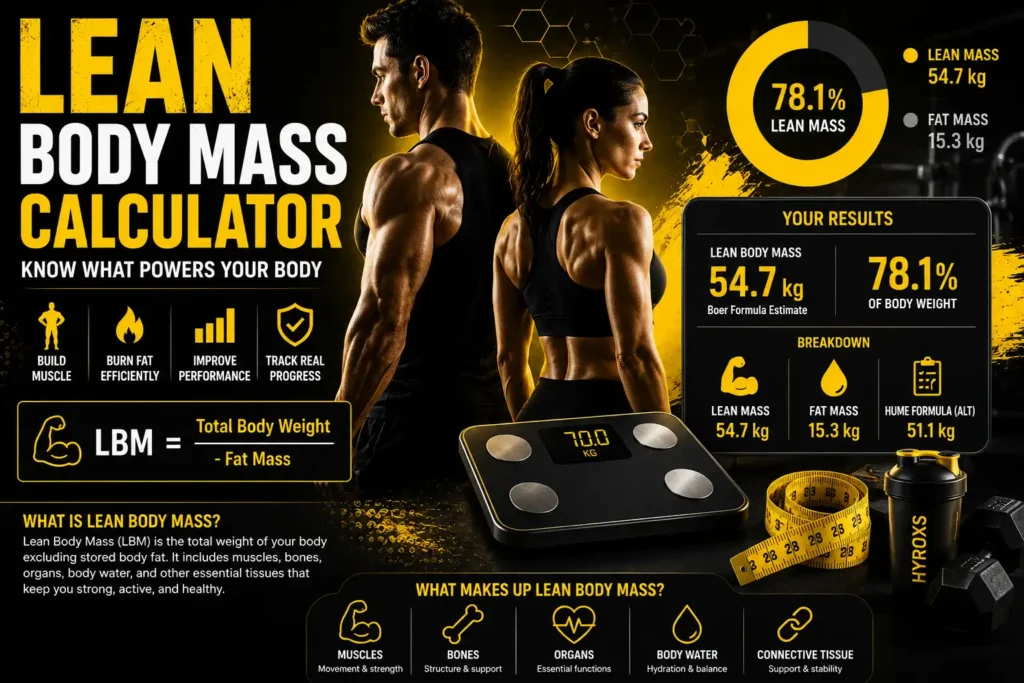
What Is Lean Body Mass?
Lean Body Mass (LBM) refers to the portion of your total body weight that is not stored body fat. It includes several important tissues and components of your body, such as muscle, bones, organs, body water, connective tissue, and other non-fat tissues.
When you step on a scale, the number you see represents your total body weight. That weight is made up of different components, including fat mass and lean mass. Understanding this difference can give you a much better picture of your body composition than looking at body weight alone.
Our Lean Body Mass Calculator estimates how much of your total body weight is made up of lean components. This can help you understand changes in your body composition when you're trying to lose fat, build muscle, improve athletic performance, or maintain a healthy body weight.
Lean Body Mass vs. Total Body Weight
Your total body weight can be thought of as two major components:
Total Body Weight = Fat Mass + Lean Body Mass
For example, if someone weighs 70 kg and has an estimated body fat percentage of 20%, approximately 14 kg of their weight would be fat mass.
That leaves approximately 56 kg of estimated lean body mass.
(Check Lean Body Mass Calculator)
This doesn't mean that the person has 56 kg of muscle. Lean body mass contains several different tissues and substances in addition to skeletal muscle.
This distinction is important because lean body mass is not the same thing as muscle mass.
(Check Lean Body Mass Calculator)
What Is Included in Lean Body Mass?
Lean Body Mass includes most of the weight in your body that is not classified as stored body fat. Important components include:
Muscle:
Skeletal muscle is one of the most important components of lean body mass. It allows you to move, produce force, maintain posture, and perform physical activities. Resistance training can stimulate muscle growth and help maintain muscle tissue during periods of weight loss.
Bones:
Your skeleton contributes significantly to your lean body mass. Bones provide structural support, protect vital organs, and help your body withstand physical forces.
Organs:
Vital organs such as the heart, liver, kidneys, lungs, and brain contribute to your body's lean mass. These tissues perform essential functions that keep your body operating normally.
Body Water:
A substantial portion of your body is water. Water is involved in circulation, nutrient transportation, temperature regulation, cellular function, and many other biological processes. Because hydration can change, body-composition measurements can also fluctuate.
Connective Tissue:
Tendons, ligaments, cartilage, and other connective tissues contribute to the non-fat portion of your body and help support movement and physical structure.
Because all of these components contribute to lean body mass, an LBM Calculator should not be interpreted as a direct measurement of how much skeletal muscle you have.
(Check Lean Body Mass Calculator)
Is Lean Body Mass the Same as Muscle Mass?
No. Lean Body Mass is not the same as skeletal muscle mass.
This is one of the most important things to understand when using a Lean Body Mass Calculator.
Muscle is a major component of lean body mass, but LBM also includes bones, organs, body water, connective tissues, and other non-fat components.
For example, if your Lean Body Mass is calculated as 55 kg, it would be incorrect to say that you have exactly 55 kg of muscle. The 55 kg represents an estimate of your total non-fat body mass, not just skeletal muscle.
This distinction is particularly important for athletes and people who strength train. An increase in LBM over time may indicate an improvement in lean tissue, but it does not tell you exactly how many kilograms of new skeletal muscle you have gained.
Why Is Lean Body Mass Useful?
Lean Body Mass provides useful information about your body composition that total body weight cannot provide by itself.
Imagine two people who both weigh 80 kg. One person could have considerably more body fat and less lean tissue, while the other could have more muscle and less body fat.
Their scale weight is identical, but their body composition is very different.
This is why tracking lean body mass can be useful when evaluating changes in your body.
An Lean Body Mass Calculator (Check Lean Body Mass Calculator) can help you:
Understand how your body weight is distributed between fat and lean components.
Track changes in estimated lean mass over time.
Monitor whether weight loss is accompanied by changes in lean tissue.
Evaluate body-composition changes during muscle-building phases.
Put changes in body weight into better context.
Support nutrition and training planning.
Track progress beyond the number displayed on the scale.
Lean Body Mass During Weight Loss
When you lose weight, the change on the scale does not necessarily represent fat loss alone. Changes can occur in body fat, lean tissue, water, and stored glycogen.
For someone trying to lose body fat, maintaining as much lean tissue as reasonably possible is generally an important goal.
For example, suppose someone begins a weight-loss program at:
80 kg body weight
20% body fat
64 kg estimated lean body mass
After several months, they weigh:
74 kg body weight
15% body fat
62.9 kg estimated lean body mass
The person has lost approximately 6 kg of total body weight, while the estimated lean body mass has changed by about 1.1 kg.
This provides more information than simply saying, "I lost 6 kg."
An Lean Body Mass Calculator can therefore be useful when monitoring body-composition trends during a fat-loss phase. However, remember that the result is an estimate and can be affected by the accuracy of your body-fat measurement.
Lean Body Mass During Muscle Building
The same principle applies when you're trying to gain muscle.
An increase in body weight does not automatically mean that all of the additional weight is muscle. Weight gain can come from increases in muscle tissue, body fat, water, glycogen, and other components.
Tracking estimated LBM alongside body weight and body-fat percentage can help provide a broader picture.
For example, if your body weight gradually increases while your estimated body fat remains relatively stable and your estimated lean body mass increases, the overall change may be consistent with improved lean mass.
However, an Lean Body Mass Calculator cannot determine exactly how much muscle you have gained. For a more complete assessment, combine LBM with strength progression, body measurements, training performance, and other body-composition measurements.
Why Lean Body Mass Matters for Athletes
Lean body mass is particularly relevant for athletes because muscle and other lean tissues contribute to movement, strength, power, and physical performance.
For sports such as HYROX, athletes need a combination of strength, muscular endurance, running ability, cardiovascular fitness, and recovery capacity.
However, maximizing lean body mass is not automatically the same as maximizing athletic performance.
Additional body mass can be useful when it contributes to strength and power, but carrying unnecessary mass can also affect movement efficiency and endurance.
For this reason, athletes should focus on developing useful and functional lean mass rather than simply trying to increase the number shown by a Lean Body Mass Calculator.
How Lean Body Mass Relates to Body Composition
Body composition describes what your body weight is made of.
Two people can have the same body weight but very different proportions of fat and lean tissue. Likewise, a person can maintain a similar body weight while significantly changing their body composition through training and nutrition.
For example, during body recomposition, someone may lose body fat while gaining lean tissue. Their scale weight might change very little, but their body composition can improve significantly.
This is one of the main reasons body-composition measurements can provide information that body weight alone cannot.
Understanding Your Lean Body Mass Calculator Result
When you use the Lean Body Mass Calculator, remember that the result is an estimate, not a direct laboratory measurement.
Your result may depend on:
Your height
Your body weight
Your gender
Your estimated body-fat percentage
The formula being used
The population on which the formula was developed
The accuracy of your measurements
Different formulas can also produce slightly different LBM estimates for the same person. This is why your calculator may show results from multiple equations such as the Boer Formula and Hume Formula.
Instead of becoming concerned about small differences between formulas, use the results as a reference and focus on consistent measurements and long-term trends.
https://youtu.be/RDD9RuGjM08?si=7JCCHjKNJq66FMKW Lean Body Mass CalculatorLean Body Mass Calculator: Measure the Weight That Powers Your Body
Your body weight is made up of more than just fat. It also includes muscles, bones, organs, water, and other essential tissues that keep you healthy and active. The HYROXS Lean Body Mass Calculator estimates how much of your body weight comes from these non-fat components, helping you better understand your body composition.
Whether you're trying to build muscle, lose body fat, or improve athletic performance, knowing your lean body mass gives you valuable insight beyond the number on the scale. It can help you set realistic fitness goals, monitor progress more accurately, and make better nutrition and training decisions.
(Check Lean Body Mass Calculator)
Lean Body Mass CalculatorWhat Makes Up Lean Body Mass?
Lean Body Mass includes every part of your body except stored body fat. While muscles make up the largest portion, several other tissues also contribute to your LBM. (Check Lean Body Mass Calculator)
| Component | Role in the Body |
|---|---|
| Muscles | Produce movement, strength, and support metabolism. |
| Bones | Provide structure, stability, and protect vital organs. |
| Organs | Carry out essential functions such as breathing, digestion, and circulation. |
| Body Water | Supports hydration, nutrient transport, and temperature regulation. |
| Connective Tissue | Includes tendons, ligaments, and cartilage that support movement. |
Together, these components make up your lean body mass and are essential for maintaining good health and physical performance.
Lean Body Mass CalculatorHow the HYROXS Lean Body Mass Calculator Works
The HYROXS Lean Body Mass Calculator estimates your lean mass using scientifically validated equations based on your:
- Gender
- Height
- Weight
- Selected calculation formula
Depending on the calculator settings, you may also be able to estimate lean body mass using your body fat percentage for an even more personalized result.
Rather than measuring body fat directly, these formulas provide a reliable estimate that can be used to track long-term progress and support your fitness planning.
Lean Body Mass Calculation Formulas
Several scientific formulas have been developed to estimate Lean Body Mass. Each uses slightly different calculations, but all are widely accepted in fitness and healthcare.
Boer Formula
The Boer Formula is considered one of the most reliable methods for estimating Lean Body Mass in healthy adults and is commonly used in sports science and clinical settings.
Hume Formula
The Hume Formula is another well-established equation that estimates lean body mass using height and body weight. It is frequently used in medical and pharmaceutical applications.
James Formula
The James Formula offers an alternative method for estimating Lean Body Mass and is commonly included in body composition calculators. While simple to apply, it may produce slightly different results depending on body type.
Lean Body Mass vs Body Weight
Many people assume that losing weight automatically means becoming healthier, but that's not always true. During weight loss, it's possible to lose both body fat and muscle if nutrition and training aren't managed properly.
| Body Weight | Lean Body Mass |
|---|---|
| Includes fat and lean tissue | Includes only non-fat tissues |
| Changes with water weight | Reflects muscles, bones, organs, and body water |
| Doesn't show body composition | Helps evaluate muscle preservation and growth |
| Useful for tracking weight changes | Better for tracking fitness progress |
For this reason, many athletes and fitness professionals pay closer attention to Lean Body Mass (Check Lean Body Mass Calculator) than body weight alone.
Lean Body Mass CalculatorHow to Use Your Lean Body Mass Results
Your Lean Body Mass result is more than just a number—it's a useful benchmark for planning your fitness journey. By understanding how much of your body is made up of muscles, bones, organs, and other lean tissues, you can make more informed decisions about your nutrition, training, and overall health. (Check Lean Body Mass Calculator)
Here's how you can use your result effectively:
For Fat Loss
If your goal is to lose weight, aim to reduce body fat while preserving as much lean body mass as possible. A combination of strength training, sufficient protein intake, and a moderate calorie deficit can help maintain muscle during weight loss.
For Muscle Building
If you're trying to increase muscle size and strength, tracking your Lean Body Mass helps you determine whether your weight gain comes from muscle rather than excess body fat.
For General Health
Maintaining a healthy amount of lean body mass supports better metabolism, mobility, bone strength, and long-term physical function, especially as you age.
Ways to Improve Lean Body Mass
Increasing Lean Body Mass requires consistency in both training and nutrition. Small improvements over time can lead to significant changes in body composition.
Follow a Structured Strength Training Program
Resistance training is the most effective way to build lean muscle. Focus on compound movements such as squats, deadlifts, bench presses, rows, pull-ups, and overhead presses to stimulate multiple muscle groups.
Train each major muscle group at least 2–3 times per week and gradually increase the weight or repetitions as your strength improves. (Check Lean Body Mass Calculator)
Prioritize Protein Intake
Protein provides the building blocks your muscles need to recover and grow after exercise.
Aim for approximately 1.6–2.2 grams of protein per kilogram of body weight each day if your goal is to increase or maintain lean body mass.
Excellent protein sources include:
- Chicken breast
- Fish
- Eggs
- Greek yogurt
- Cottage cheese
- Lean beef
- Tofu
- Lentils
- Whey protein
Support Muscle Growth with Proper Nutrition
Building lean muscle requires enough energy to support recovery and growth. Instead of following restrictive diets, focus on eating balanced meals that include:
- High-quality protein
- Complex carbohydrates
- Healthy fats
- Fruits and vegetables
- Plenty of water
If your goal is muscle gain, a small calorie surplus combined with resistance training generally produces the best results.
Don't Overlook Recovery
Muscles grow during recovery—not while you're training.
To maximize recovery:
- Sleep 7–9 hours each night.
- Stay hydrated.
- Manage stress effectively.
- Include rest days in your training program.
Good recovery habits help improve strength, reduce injury risk, and support long-term muscle growth.
Lean Body Mass and Your Fitness Goals
(Check Lean Body Mass Calculator)
Your ideal Lean Body Mass depends on what you're trying to achieve. Rather than comparing yourself to others, use your results to measure personal progress over time.
| Fitness Goal | How Lean Body Mass Helps |
|---|---|
| Weight Loss | Helps preserve muscle while reducing body fat. |
| Muscle Gain | Tracks increases in lean tissue over time. |
| Athletic Performance | Supports improvements in strength, speed, and endurance. |
| Healthy Aging | Helps maintain mobility, balance, and independence. |
| General Fitness | Provides a better picture of body composition than body weight alone. |
Tracking Lean Body Mass regularly allows you to see whether your training and nutrition are moving you closer to your goals.
Lean Body Mass vs Fat-Free Mass
The terms Lean Body Mass (LBM) and Fat-Free Mass (FFM) are often used interchangeably, but they are not exactly the same.
| Lean Body Mass (LBM) | Fat-Free Mass (FFM) |
|---|---|
| Includes muscles, bones, organs, body water, and essential fat | Includes all non-fat tissues only |
| Commonly used in fitness and sports | Frequently used in scientific research |
| Slightly higher measurement | Slightly lower measurement |
| Practical for everyday fitness tracking | More common in laboratory assessments |
For most fitness purposes, the difference between LBM and FFM is very small, and either measurement provides valuable insight into body composition.
Lean Body Mass CalculatorResistance training is one of the most important strategies for increasing or maintaining muscle mass. The American College of Sports Medicine's 2026 evidence review synthesized 137 systematic reviews involving more than 30,000 participants and evaluated how resistance-training variables affect muscle hypertrophy, strength, power, endurance and physical function.
Read the ACSM 2026 Resistance Training Guidelines
Frequently asked questions (FAQs)
What is Lean Body Mass?
Lean Body Mass (LBM) is the total weight of your body excluding stored body fat. It includes muscles, bones, organs, body water, connective tissues, and other essential non-fat components.
Why is Lean Body Mass important?
Lean Body Mass helps you understand your body composition more accurately than body weight alone. It is useful for tracking muscle growth, preserving muscle during fat loss, and planning nutrition and training.
How is Lean Body Mass calculated?
The HYROXS Lean Body Mass Calculator estimates your LBM using scientifically validated formulas based on your height, weight, gender, and selected calculation method.
Which Lean Body Mass formula is the most accurate?
The Boer Formula is widely regarded as one of the most accurate equations for estimating Lean Body Mass in healthy adults. However, the Hume and James formulas are also commonly used and provide reliable estimates.
Is Lean Body Mass the same as muscle mass?
No. Muscle mass is one part of Lean Body Mass. LBM also includes bones, organs, body water, connective tissue, and other non-fat components.
Lean Body Mass (LBM) is the total weight of your body excluding stored body fat. It includes muscles, bones, organs, body water, connective tissues, and other essential non-fat components.
Lean Body Mass helps you understand your body composition more accurately than body weight alone. It is useful for tracking muscle growth, preserving muscle during fat loss, and planning nutrition and training.
The HYROXS Lean Body Mass Calculator estimates your LBM using scientifically validated formulas based on your height, weight, gender, and selected calculation method.
The Boer Formula is widely regarded as one of the most accurate equations for estimating Lean Body Mass in healthy adults. However, the Hume and James formulas are also commonly used and provide reliable estimates.
No. Muscle mass is one part of Lean Body Mass. LBM also includes bones, organs, body water, connective tissue, and other non-fat components.