
FFMI Calculator: Discover Your Natural Muscle Building Potential
FFMI Calculator: Discover Your Natural Muscle Building Potential
Want to know how much muscle mass you carry relative to your height — and what's realistically achievable without drugs? Our free FFMI Calculator gives you an instant, science-based Fat-Free Mass Index score so you can track real progress and set goals grounded in reality.
This guide explains exactly what FFMI is, how it's calculated, what your number means, and how to use the calculator below to get your personalized result in seconds.
FFMI Calculator
80 kg 40 kg180 kg 180 cm 140 cm220 cm 15 % 3 %50 % FFMI 22.50 Fat-Free Mass Index Normalized FFMI 22.80 Good Know Your Natural PotentialFFMI helps you set realistic muscle-building goals based on decades of research into natural athletes. Track it over time to confirm real progress.
Get Training Tips #ffmi-calc-widget input[type=range] { background: linear-gradient(to right, #f5e94e 0%, #f5e94e 0%, #333 0%, #333 100%); border: none; box-shadow: none; } #ffmi-calc-widget input[type=range]::-webkit-slider-thumb { -webkit-appearance: none; width: 24px; height: 24px; border-radius: 50%; background: #ffffff; border: none; cursor: pointer; box-shadow: none; } #ffmi-calc-widget input[type=range]::-moz-range-thumb { width: 24px; height: 24px; border-radius: 50%; background: #ffffff; border: none; cursor: pointer; box-shadow: none; } #ffmi-calc-widget input[type=range]::-moz-range-track { background: transparent; border: none; box-shadow: none; } #ffmi-calc-widget input[type=range]::-webkit-slider-runnable-track { border: none; box-shadow: none; background: transparent; } :root { --hx-bg-dark: #000000; /* Page background - Black */ --hx-card-bg: #111111; /* Card background - Dark Black */ --hx-card-border: #FFD400; /* Yellow border */ --hx-accent: #FFD400; /* Primary Yellow */ --hx-accent-light: #FFE44D; /* Light Yellow */ --hx-text-primary: #FFFFFF; /* White text */ --hx-text-secondary: #D6D6D6; /* Light Gray text */ --hx-radius: 14px; } .hx-calc-hub { background: var(--hx-bg-dark); padding: 64px 20px; font-family: 'Inter', 'Helvetica Neue', Arial, sans-serif; } .hx-calc-hub__inner { max-width: 1160px; margin: 0 auto; } .hx-calc-hub__eyebrow { display: block; text-align: center; color: var(--hx-accent); font-size: 13px; font-weight: 700; letter-spacing: 1.5px; text-transform: uppercase; margin-bottom: 12px; } .hx-calc-hub__title { text-align: center; color: var(--hx-text-primary); font-size: clamp(28px, 4vw, 40px); font-weight: 800; line-height: 1.15; margin: 0 0 14px; } .hx-calc-hub__subtitle { text-align: center; color: var(--hx-text-secondary); font-size: 16px; max-width: 620px; margin: 0 auto 48px; line-height: 1.6; } .hx-calc-grid { display: grid; grid-template-columns: repeat(4, 1fr); gap: 20px; } @media (max-width: 900px) { .hx-calc-grid { grid-template-columns: repeat(2, 1fr); } } @media (max-width: 540px) { .hx-calc-grid { grid-template-columns: 1fr; } } .hx-calc-card { display: flex; flex-direction: column; background: var(--hx-card-bg); border: 1px solid var(--hx-card-border); border-radius: var(--hx-radius); padding: 28px 22px; text-decoration: none; transition: transform 0.2s ease, border-color 0.2s ease, background 0.2s ease; } .hx-calc-card:hover { transform: translateY(-4px); border-color: var(--hx-accent); background: #000000; } .hx-calc-card__icon { width: 46px; height: 46px; border-radius: 10px; background: rgba(255, 90, 31, 0.12); display: flex; align-items: center; justify-content: center; margin-bottom: 18px; } .hx-calc-card__icon svg { width: 22px; height: 22px; stroke: var(--hx-accent); } .hx-calc-card__title { color: var(--hx-text-primary); font-size: 17px; font-weight: 700; margin: 0 0 8px; line-height: 1.3; } .hx-calc-card__desc { color: var(--hx-text-secondary); font-size: 13.5px; line-height: 1.55; margin: 0 0 20px; flex-grow: 1; } .hx-calc-card__cta { display: inline-flex; align-items: center; gap: 6px; color: var(--hx-accent-light); font-size: 13px; font-weight: 700; text-transform: uppercase; letter-spacing: 0.5px; } .hx-calc-card__cta svg { width: 14px; height: 14px; stroke: var(--hx-accent-light); transition: transform 0.2s ease; } .hx-calc-card:hover .hx-calc-card__cta svg { transform: translateX(4px); }Check for other Fitness calculators
Every metric you need to understand your body composition, energy needs, and true fitness potential — free, science-backed, and built for HYROX athletes.
Body Fat Percentage Calculator
Estimate your body fat using the U.S. Navy circumference method.
Calculate nowBMI Calculator
Check your body mass index and see where you fall on the standard scale.
Calculate nowBMR Calculator
Find your basal metabolic rate — the calories your body burns at rest.
Calculate nowCalorie Calculator
Get your daily calorie needs for maintenance, fat loss, or muscle gain.
Calculate nowLean Body Mass Calculator
Find out how much of your weight is muscle, bone, and organ mass.
Calculate nowIdeal Weight Calculator
Get your ideal weight range based on height, gender, and frame.
Calculate nowBody Recomposition Calculator
Plan your fat loss and muscle gain targets at the same time.
Calculate nowWhat Is FFMI (Fat-Free Mass Index)?
Fat-Free Mass Index (FFMI) is a science-based metric that measures the amount of muscle mass relative to height, independent of body fat percentage. Unlike BMI, which doesn't distinguish between fat and muscle mass, FFMI gives an accurate picture of muscular development and what's achievable naturally without performance-enhancing drugs.
Developed by researchers studying bodybuilders, FFMI has become the standard for assessing muscle mass, setting realistic fitness goals, and identifying natural genetic limits.
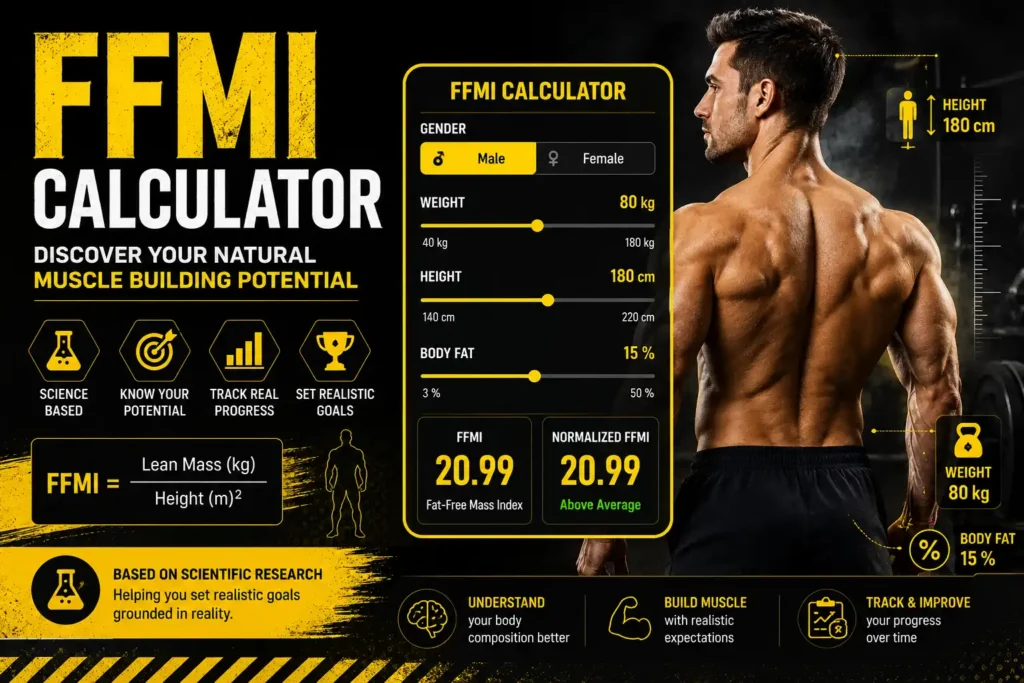
FFMI vs Normalized FFMI: What's the Difference?
Your FFMI Calculator provides both a standard FFMI score and a Normalized FFMI score. Although they are related, they serve slightly different purposes.
Standard FFMI
Standard FFMI calculates your estimated fat-free mass relative to your height. It provides a simple measure of lean mass in relation to body size.
Normalized FFMI
Normalized FFMI adjusts the standard FFMI for height using a reference height of 1.80 meters. This makes comparisons between people of different heights more meaningful.
The FFMI Calculator displays both values so you can understand your raw FFMI and your height-adjusted result.
What Does Your FFMI Score Mean?
Your FFMI Calculator result estimates how much fat-free mass you carry relative to your height. A higher FFMI generally indicates a greater amount of lean mass relative to body size, but your score should always be considered alongside your body fat percentage, training history, genetics, and overall fitness.
An FFMI score is not a direct measurement of skeletal muscle, strength, or athletic performance. Instead, it is best used as a body-composition reference that can help you understand and track changes in your lean mass over time.
Tip: Use the FFMI Calculator under similar measurement conditions each time. Consistent measurements make changes in your FFMI more useful for tracking long-term progress.
The Science Behind FFMI
A landmark 1995 study published in the Journal of Clinical Endocrinology & Metabolism analyzed the body composition of elite bodybuilders across different eras. Natural bodybuilders rarely exceeded an FFMI of 25, while steroid users commonly reached 26–30+. This research established FFMI as a reliable marker of natural muscular potential.
The formula accounts for the relationship between height and muscle distribution — taller individuals naturally score slightly lower even with substantial muscle mass, because that mass is spread over a larger frame. The normalized FFMI formula corrects for this height discrepancy.
What Is a Good FFMI?
There is no single FFMI score that is considered "good" for everyone. A useful FFMI range depends on factors such as sex, height, body composition, training experience, genetics, and the accuracy of your body fat measurement.
For recreational lifters, an average or above-average FFMI can represent a solid level of muscular development. Higher FFMI values generally indicate more fat-free mass relative to height, although a higher number does not automatically mean better health or athletic performance.
Rather than trying to reach one specific number, use our FFMI Calculator to monitor your own progress over months and years. A gradual improvement in FFMI can be more meaningful than comparing your result with someone else's.
Scientific fact: A 1995 study by Kouri and colleagues calculated Fat-Free Mass Index (FFMI) in 157 male athletes, including 83 anabolic-androgenic steroid users and 74 non-users. The researchers found that normalized FFMI in the non-user group extended up to approximately 25, while many steroid users had values above 25, with some exceeding 30. The authors concluded that FFMI could be useful as an initial screening measure for possible steroid use, while noting that the findings were preliminary.
Read the original FFMI research on PubMed
| FFMI Level | General Meaning |
|---|---|
| Lower | Lower fat-free mass relative to height |
| Average | Typical level of fat-free mass for the reference population |
| Above Average | Greater fat-free mass relative to height |
| High | Highly developed level of lean mass relative to height |
How FFMI Is Calculated
The calculation requires three measurements: total body weight, height, and body fat percentage.
Standard FFMI FormulaFFMI = Lean Mass (kg) ÷ Height (m)²Where Lean Mass = Total Weight × (1 − Body Fat % ÷ 100)Normalized FFMI FormulaNormalized FFMI = FFMI + 6.1 × (1.8 − Height in m)Adjusts your score to a standard height of 1.8m (5'11") so people of different heights can be fairly compared.FFMI Calculator Example
Understanding the calculation can make your FFMI Calculator result easier to interpret. Let's use an example of a person who weighs 80 kg, is 180 cm tall, and has an estimated body fat percentage of 15%.
Step 1: Calculate Fat-Free Mass
Fat-Free Mass = Weight × (1 − Body Fat ÷ 100)
80 × (1 − 15 ÷ 100) = 68 kg
Step 2: Convert Height to Meters
180 cm = 1.80 m
Step 3: Calculate FFMI
FFMI = Fat-Free Mass ÷ Height²
68 ÷ (1.80 × 1.80) = 20.99
In this example, the calculated FFMI is approximately 20.99. Our FFMI Calculator performs these calculations automatically when you enter your weight, height, and estimated body fat percentage.
How Accurate Is the FFMI Calculator?
The mathematical calculation performed by an FFMI Calculator is straightforward, but the accuracy of your final result depends on the accuracy of the measurements you enter.
Weight and height can usually be measured quite consistently. Body fat percentage is more difficult to determine, and different methods can produce different estimates.
For More Consistent Results
- Measure your weight under similar conditions.
- Use the same body-fat measurement method when possible.
- Measure your height accurately.
- Avoid comparing measurements taken under completely different conditions.
- Focus on long-term trends rather than a single FFMI result.
Remember: FFMI estimates fat-free mass relative to height. It does not directly measure skeletal muscle mass, strength, or athletic performance.
What Factors Affect Your FFMI Score?
Several factors can influence the number shown by an FFMI Calculator. Understanding these factors can help you interpret your result more accurately.
Body Weight
Body weight is used to estimate your fat-free mass, so changes in weight can affect your FFMI.
Body Fat Percentage
Body fat percentage is an important input because FFMI is based on estimated fat-free mass.
Height
Height is part of the FFMI formula and is also used when calculating Normalized FFMI.
Training Experience
Consistent resistance training can increase lean mass over time and may therefore increase FFMI.
Genetics
Individual differences in body structure and muscle-building ability can influence your FFMI.
Measurement Accuracy
An inaccurate body-fat estimate can affect the FFMI result produced by the calculator.
How to Increase Your FFMI Naturally
If your goal is to increase your FFMI, the primary objective is to build and maintain more lean mass while managing body fat. Your FFMI Calculator can help you track changes as you progress.
Progressive Training
Follow a structured resistance-training program and gradually challenge your muscles over time.
Adequate Protein
Consume enough protein as part of a balanced diet to support muscle maintenance and growth.
Recovery
Give your body enough recovery time and prioritize consistent, quality sleep.
Track Progress
Use your FFMI Calculator result alongside body weight, measurements, training performance, and progress photos.
FFMI vs Normalized FFMI: What's the Difference?
Your FFMI Calculator provides both a standard FFMI score and a Normalized FFMI score. Although they are related, they serve slightly different purposes.
Standard FFMI
Standard FFMI calculates your estimated fat-free mass relative to your height. It provides a simple measure of lean mass in relation to body size.
Normalized FFMI
Normalized FFMI adjusts the standard FFMI for height using a reference height of 1.80 meters. This makes comparisons between people of different heights more meaningful.
The FFMI Calculator displays both values so you can understand your raw FFMI and your height-adjusted result.
FFMI vs BMI: Why FFMI Is Better for Athletes
BMI has real limitations for anyone with above-average muscle mass. A muscular person with 10% body fat can be classified as "overweight" by BMI standards, despite being lean and healthy — because BMI only looks at weight and height, with no distinction between muscle and fat.
| Metric | Measures | Best For | Limitations |
|---|---|---|---|
| BMI | Weight relative to height | General population screening | Doesn't separate muscle from fat |
| FFMI | Muscle mass relative to height | Athletes, bodybuilders, lifters | Requires accurate body fat reading |
| Body Fat % | % of weight as fat | Assessing leanness | Doesn't indicate muscle mass |
| Lean Body Mass | Total muscle, bone, organ weight | Absolute muscle tracking | Not normalized for height |
FFMI Classification for Men
| FFMI Range | Classification | Training Level |
|---|---|---|
| 14-17 | Low / Very Low | Untrained |
| 17-18 | Below Average | Little to no training |
| 18-20 | Average | Recreational training |
| 20-21 | Above Average | 6-12 months consistent |
| 21-22 | Good | 1-2 years dedicated |
| 22-23 | Excellent | 3-5 years dedicated |
| 23-25 | Superior / Outstanding | 5-10 years elite |
| 25-26 | Exceptional (natural limit) | 10+ years, exceptional genetics |
| 26+ | Highly Suspected / Enhanced | Beyond typical natural limits |
FFMI Classification for Women
| FFMI Range | Classification | Training Level |
|---|---|---|
| 11-13 | Low / Very Low | Untrained |
| 13-14 | Below Average | Little to no training |
| 14-16 | Average | Recreational training |
| 16-17 | Above Average | 6-18 months consistent |
| 17-18 | Excellent | 2-4 years dedicated |
| 18-20 | Superior / Outstanding | 4-7+ years elite |
| 20-21 | Exceptional (natural limit) | 10+ years, exceptional genetics |
| 21+ | Highly Suspected / Enhanced | Beyond typical natural limits |
Important Context: Women naturally score 4–6 FFMI points lower than men due to hormonal differences — testosterone levels in men are 10–20x higher, driving much greater muscle-building capacity. A woman with FFMI 18 has achieved development proportionally similar to a man with FFMI 23.
Why FFMI Matters for Your Fitness Journey
1. Set Realistic Expectations
FFMI shows you what's naturally achievable, instead of comparing yourself to enhanced athletes or unrealistic social media physiques.
2. Track Meaningful Progress
Unlike scale weight, FFMI isolates muscle mass changes — useful during cutting phases when weight drops but muscle is preserved.
3. Identify Plateaus Accurately
A stalled FFMI after months of proper training may mean you're nearing your genetic ceiling rather than doing something wrong.
How to Use the FFMI Calculator
- Select your gender (male or female).
- Move the Weight slider to match your current body weight.
- Move the Height slider to match your height.
- Move the Body Fat slider to match your estimated body fat percentage.
- Your FFMI and Normalized FFMI update instantly, along with your classification.
FFMI and Your Training Goals
Your ideal FFMI target depends on your individual goals.
Someone training primarily for general health may not need to pursue a high FFMI. A recreational lifter may want to gradually increase lean mass, while a competitive bodybuilder may have very different body-composition goals.
Athletes also have sport-specific requirements. For example, a HYROX athlete needs more than muscularity alone. Strength, running ability, aerobic capacity, power, endurance, recovery, and movement efficiency can all influence performance.
Therefore, a higher FFMI is not automatically better.
Use your FFMI Calculator to understand your current body composition, but choose your training and nutrition goals based on what you actually want to achieve.
How to Get the Most From an FFMI Calculator
To make your FFMI results more useful, consistency is more important than chasing perfect measurements.
Follow these simple guidelines:
1. Measure your weight consistently
Try to weigh yourself under similar conditions, such as at the same time of day.
2. Use a consistent body-fat method
Switching between different body-fat estimation methods can make your FFMI results harder to compare.
3. Don't overreact to small changes
A small increase or decrease in FFMI does not necessarily mean you gained or lost muscle.
4. Look at trends
Compare measurements over several weeks or months rather than focusing on one result.
5. Combine FFMI with other metrics
Use your FFMI alongside body weight, waist measurements, strength levels, progress photos, and training performance.
The goal of an FFMI Calculator is to give you useful context—not to reduce your entire fitness journey to a single number.
Should You Try to Reach FFMI 25?
FFMI 25 is frequently discussed online as a benchmark for natural muscularity, particularly for men. However, it should not be treated as a guaranteed biological limit that applies identically to every person.
Your genetics, body structure, training history, body-fat estimate, and measurement method can all influence your FFMI.
Instead of making FFMI 25 your mandatory goal, use your FFMI Calculator to establish your current baseline and track how your body composition changes over time.
A sustainable training program and realistic expectations are much more valuable than trying to reach an arbitrary number as quickly as possible.