
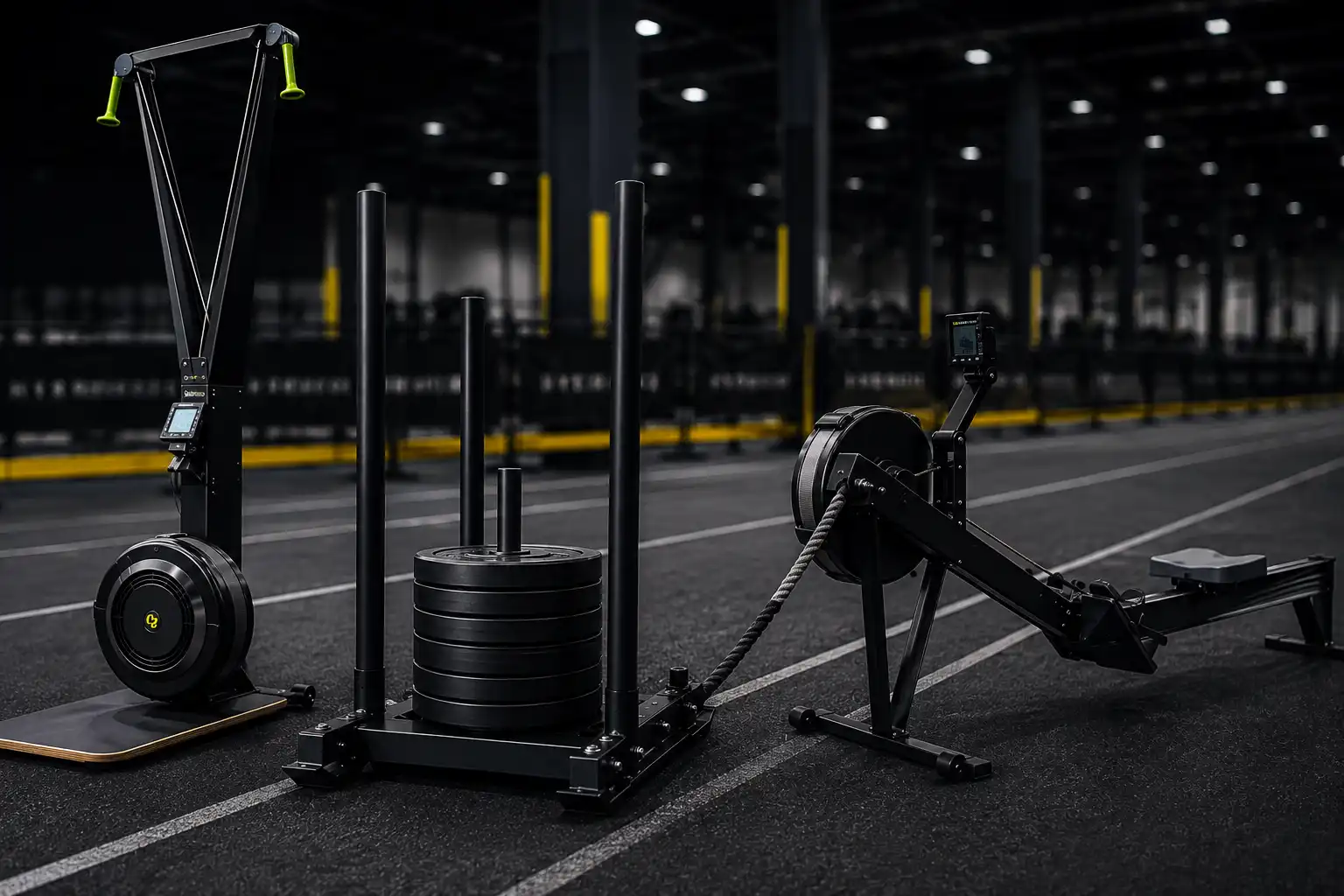
HYROX Machine Guide: Every Race and Training Machine Explained
Ask any HYROX athlete which station scares them most and the answer is almost always a machine. The SkiErg, the rowing machine, and the sled are the three pieces of equipment that separate a controlled race from a blown-up one. Unlike the running kilometers, these stations reward technique and pacing over raw effort, which means understanding the machines themselves is just as important as training on them.
This guide breaks down every HYROX machine you will see on race day, plus the training machines top athletes use to prepare, so you know exactly what to expect and how to build a setup around it. For the full gear breakdown including sandbags, kettlebells, and wall balls, see the HYROX training equipment list.
What Machines Are Used in HYROX?
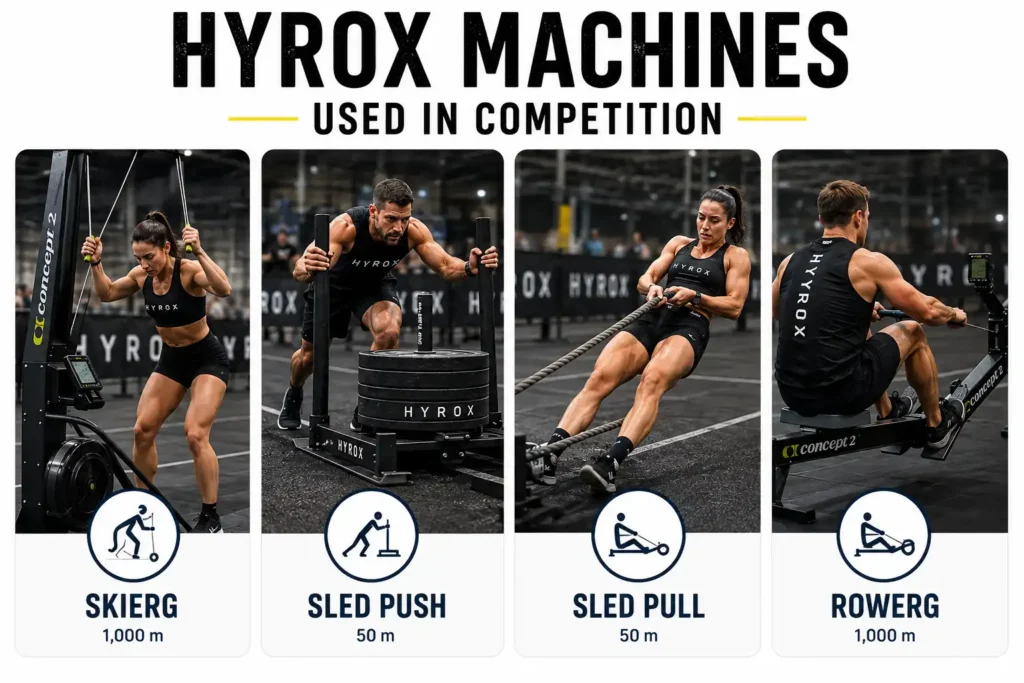
HYROX races use four machines on the competition floor: the Concept2 SkiErg (Station 1), the sled for both push and pull (Stations 2 and 3), and the Concept2 RowErg (Station 5). Every one of these is standardized — the exact same equipment and monitor greet you whether you race in Chicago, London, or Cape Town, which is why practicing on the real machines matters more in HYROX than in almost any other race format.
Outside of race day, athletes train on a wider set of machines — the assault bike, Echo bike, BikeErg, curved treadmill, stair climber, and VersaClimber — to build the specific engines each race machine demands, even though none of these ever appear in competition.
HYROX race machines at a glance
Machine | Station | Distance | Resistance Type | Monitor |
Concept2 SkiErg | 1 | 1,000 m | Air resistance (flywheel + damper) | PM5 |
Sled Push | 2 | 50 m (4 × 12.5 m shuttle) | Sled weight dragged across turf | None |
Sled Pull | 3 | 50 m (4 × 12.5 m shuttle) | Sled weight dragged across turf | None |
Concept2 RowErg | 5 | 1,000 m | Air resistance (flywheel + damper) | PM5 |
Both Concept2 ergometers run on the same PM5 performance monitor, preset to a damper setting of 6 for all divisions per the official HYROX rulebook. If you already train on a Concept2 SkiErg or RowErg at your gym, the display, damper feel, and pacing numbers on race day will be identical to what you already know.
Official HYROX Race Machines
These four are the only machines you will physically touch during a HYROX race. Everything else in the eight stations — wall balls, kettlebells, the sandbag, farmer’s carry handles — is loaded equipment rather than a machine, since it has no resistance mechanism of its own.
Concept2 SkiErg (Station 1)
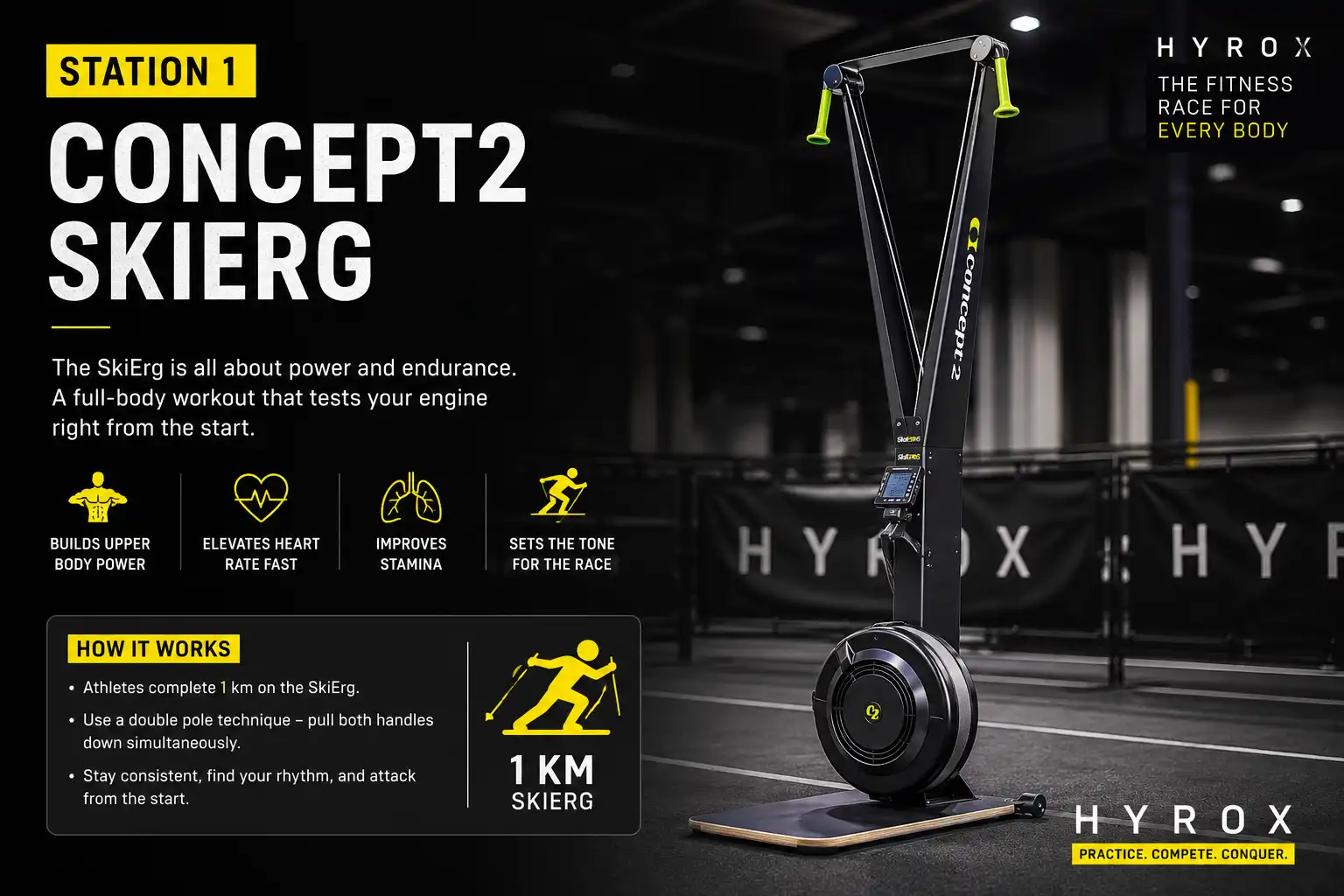
The SkiErg is the first station of every HYROX race, arriving right off the opening 1 km run while your heart rate is already elevated. It’s a vertical, standing machine that mimics the double-pole motion of cross-country skiing, and the way you handle its opening meters sets the tone for the rest of the race.
Why HYROX Uses This Machine
The SkiErg tests full-body pulling power under cardiovascular load at the exact moment fatigue starts to compound. Because it’s standardized worldwide, it also gives HYROX a way to compare performance across every venue on identical equipment — something a bodyweight movement can’t offer.
How the Machine Works
The SkiErg uses the same flywheel-and-air-resistance system as a Concept2 rower, just turned vertical. Pulling the handles down spins a flywheel inside a housing; a spiral damper controls how much air enters that housing, which changes how quickly the flywheel decelerates between pulls. The PM5 monitor reads that deceleration to calculate pace, distance, and power output in real time.
SkiErg Race Specifications
- Distance: 1,000 m (500 m per athlete in Doubles)
- Damper: preset to 6 for all divisions, adjustable by the athlete at any point
- Both feet must stay on the platform for the duration of the effort
- A judge resets the monitor before the athlete starts
Difficulty Level
Moderate. The movement itself isn’t complex, but it’s easy to turn into an arm-only exercise that burns energy you’ll need later. Most athletes need several sessions before the hip-hinge pattern feels automatic.
Muscles Worked
Lats, triceps, and shoulders drive the pull, while the core (obliques and rectus abdominis) transfers force from a hip hinge rather than a squat. The glutes and hip flexors contribute through that hinge, and grip endurance becomes a factor over the full 1,000 m.
Common Beginner Mistakes
- Squatting into every pull instead of hinging at the hips, which turns the SkiErg into a leg workout
- Sprinting the first 200 m and fading hard by the halfway mark
- Pulling with the arms alone and ignoring the lats and core
- Standing too far from or too close to the machine, shortening the effective range of motion
Technique Tips
- Hinge at the hips on every pull rather than bending the knees deeply
- Initiate the drive with the lats and core, letting the arms finish the movement
- Settle into a sustainable stroke rate rather than chasing your fastest possible split early
- Keep the recovery relaxed so the next pull starts from a tall, athletic position
How to Master the SkiErg for HYROX · HYROX Training Equipment List
HYROX Sled Push (Station 2)
Overview
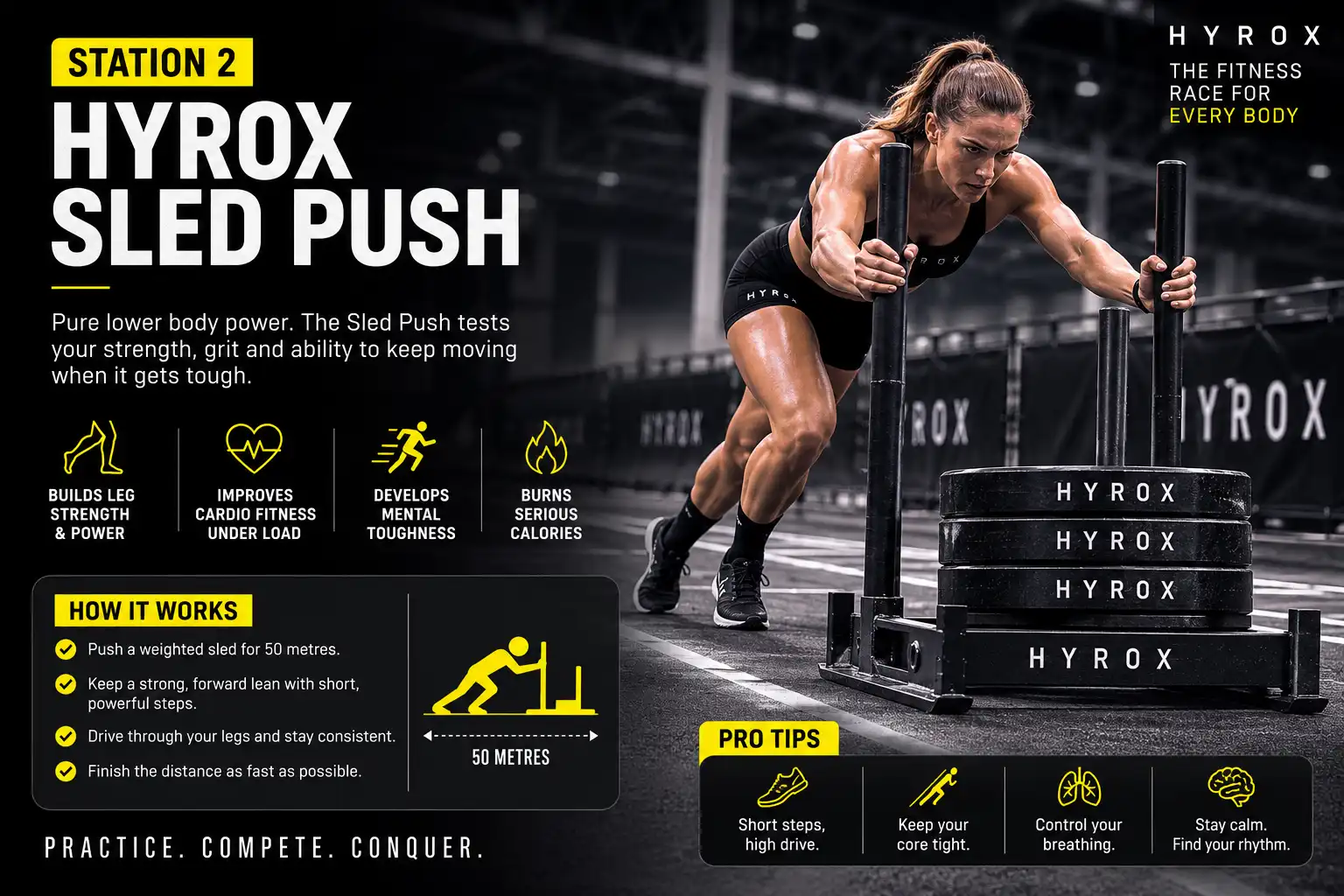
The sled push comes immediately after the SkiErg and is the station most first-time athletes fear. It combines heavy resistance with a technique demand that no amount of running or machine work fully prepares you for.
Why HYROX Uses This Machine
It’s a pure test of leg power and force production under fatigue, arriving early enough in the race that poor pacing on the SkiErg gets punished immediately. There’s no way to fake your way through a sled push with technique alone — it requires genuine lower-body strength.
Why HYROX Uses This Machine
It’s a pure test of leg power and force production under fatigue, arriving early enough in the race that poor pacing on the SkiErg gets punished immediately. There’s no way to fake your way through a sled push with technique alone — it requires genuine lower-body strength.
How the Machine Works
A HYROX sled is a metal frame loaded with weight plates that sits on two runners. Athletes drive it forward by pushing against upright poles or handles, and the resistance comes almost entirely from friction between the sled’s runners and the competition turf — which is noticeably slower than a smooth gym floor, catching many athletes off guard on race day.
Sled Push Race Specifications
Distance is 50 m total, broken into four 12.5 m lengths, for every division. Total sled weight (including the sled itself) varies by division:
Division | Total Weight |
Open Women | 102 kg |
Open Men / Pro Women | 152 kg |
Pro Men | 202 kg |
Doubles and Relay generally follow the Open standards for the athlete completing the station. HYROX updates weight standards periodically, so confirm the current numbers on the official HYROX rulebook before race day.
Difficulty Level
High. This is a strength-and-technique combination that surprises even strong athletes the first time they push on race-day turf instead of a gym floor.
Muscles Worked
Quads, glutes, and calves generate the drive, while the core and shoulders work isometrically to keep the arms locked and transfer force through the frame rather than absorbing it in the joints.
Common Beginner Mistakes
- Standing too upright instead of taking a low, forward-leaning position
- Taking short, choppy steps that stall momentum instead of continuous drive
- Locking the knees out fully between steps, which kills power transfer
- Stopping when the sled feels stuck rather than resetting the lean and driving through
Technique Tips
- Take a low, forward lean with the hips underneath the shoulders
- Lock the arms straight so force travels through the frame instead of the shoulders
- Drive through the whole foot with short, powerful, continuous steps
- Keep moving even at a reduced pace — stopping and restarting costs more time than slowing down
HYROX Sled Pull (Station 3)
Overview
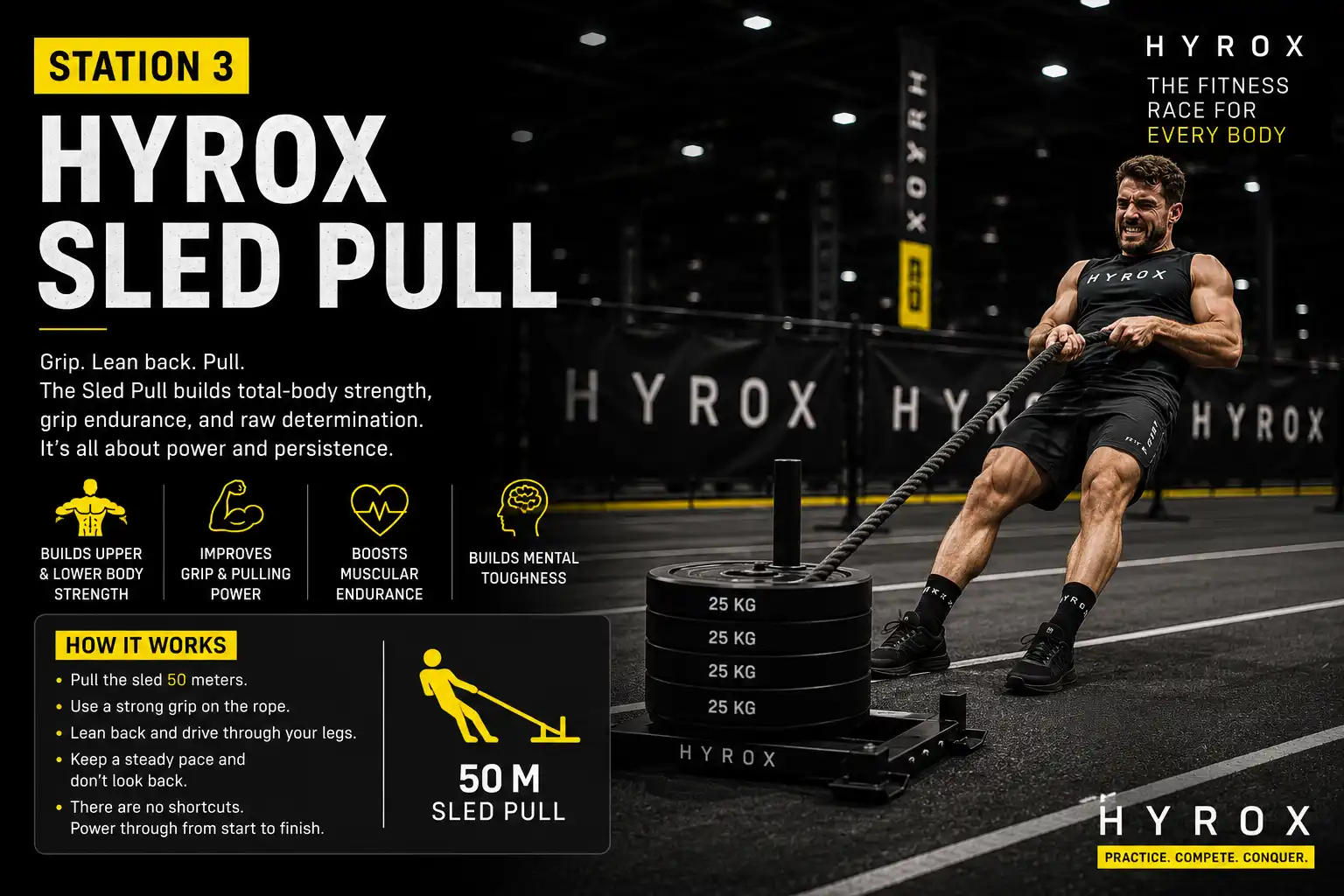
The sled pull follows immediately after the push, using the same sled but a completely different movement pattern. Where the push tests raw leg power, the pull tests posterior-chain strength and grip endurance at the exact moment your arms and back are already tired.
Why HYROX Uses This Machine
It balances the pushing demand of the previous station with a pulling pattern, and it’s deliberately placed right after the push so athletes have to manage compounding fatigue rather than resting between the two sled efforts.
How the Machine Works
A rope is attached to the same weighted sled used for the push. The athlete leans back, walks backward using leg drive, and pulls the rope hand over hand to bring the sled toward them. Resistance still comes from turf friction under the sled’s weight, but the pulling angle shifts the load toward the back, hamstrings, and grip.
Sled Pull Race Specifications
Distance is 50 m total, broken into four 12.5 m lengths, matching the push. Total sled weight by division:
Division | Total Weight |
Open Women | 78 kg |
Open Men / Pro Women | 103 kg |
Pro Men | 153 kg |
As with the push, confirm current weights on the official HYROX rulebook, since standards are reviewed each season.
Difficulty Level
High. Grip and lat fatigue tend to fail before the legs do, and coordinating a backward walk while maintaining rope tension takes real practice.
Muscles Worked
Hamstrings and glutes drive the backward walk, while the lats, rhomboids, and forearms handle the pulling and grip demand. The core stabilizes the leaned-back position throughout.
Common Beginner Mistakes
- Pulling with the arms alone instead of driving the walk with the legs
- Standing too upright rather than leaning back into the rope
- Losing tension on the rope between pulls, which wastes distance and effort
- Resetting hand position too slowly, breaking rhythm
Technique Tips
- Lean back at a controlled angle before starting each pull
- Drive the walk backward with the legs; let the arms finish the pull
- Keep constant tension on the rope rather than pulling in jerky bursts
- Keep the chest up to protect the lower back under load
Sled Pull Equipment Overview · HYROX Training Equipment List
Concept2 RowErg (Station 5)
Overview
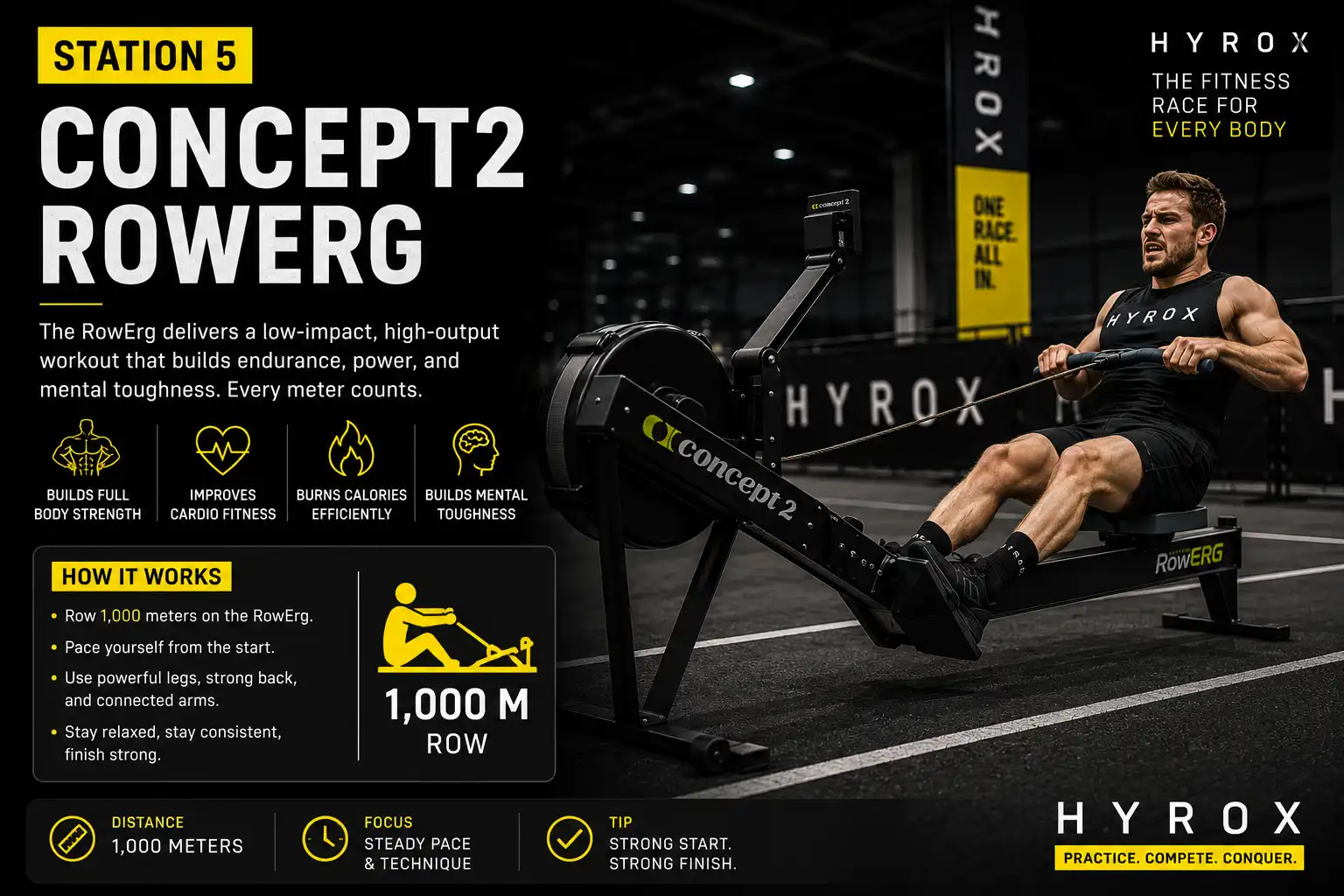
The RowErg sits at the midpoint of the race, arriving after the sled push, sled pull, and burpee broad jumps. By this point most athletes’ legs are already fatigued, which makes the RowErg’s seated, full-body demand feel very different from the standing SkiErg.
Why HYROX Uses This Machine
Where the SkiErg leans on upper-body pulling with a hip-hinge assist, the RowErg shifts more of the load toward the legs and hips before the arms finish the stroke. Training only one of the two ergometers leaves a real gap at the other, which is exactly why HYROX includes both.
How the Machine Works
The RowErg uses the same flywheel and air-resistance system as the SkiErg, just in a seated, horizontal orientation. Driving the legs, then hips, then arms pulls a chain that spins the flywheel; the damper again controls airflow into the flywheel housing, and the PM5 monitor calculates pace from how quickly the flywheel decelerates between strokes.
RowErg Race Specifications
- Distance: 1,000 m (500 m per athlete in Doubles)
- Damper: preset to 6 for all divisions, adjustable by the athlete at any point
- Feet must stay strapped in for the entire effort
- A judge resets the monitor before the athlete starts, and confirms completion before the athlete leaves the seat
Difficulty Level
Moderate. The stroke sequence itself is simple to learn, but managing effort here — arriving with tired legs, mid-race — is a genuine pacing skill.
Muscles Worked
Quads, glutes, and hamstrings drive the stroke, the lats and rhomboids finish the pull, and the biceps and core assist throughout. Grip endurance also plays a role over the full 1,000 m.
Common Beginner Mistakes
- Pulling with the arms and back before the legs finish driving
- Rushing the recovery instead of controlling the slide back up the rail
- Choosing a stroke rate that’s too high and burning energy needed for later stations
- Spending too long adjusting foot straps before starting
Technique Tips
- Sequence the drive as legs, then hips, then arms — and reverse that order on the recovery
- Hold a stroke rate you can sustain for the full distance rather than sprinting early
- Set foot straps snugly but quickly to avoid wasting time at the start
- Keep the shoulders relaxed on the recovery to conserve energy for the stations ahead
How to Master the Row for HYROX · HYROX Training Equipment List
Frequently asked questions about HYROX training machines
Which machines do I actually need for HYROX training?
The shortlist is short: a SkiErg, a rower, a treadmill and ideally an air bike covers the race's erg and running demands. Sleds, wall-ball targets and sandbags are gym-dependent, but every one of them has a substitute if your gym lacks them.
Can I train for HYROX without a SkiErg or rower?
Yes. The SkiErg substitutes well with band pulldowns, kettlebell swings or burpees; rowing replaces itself with air-bike intervals or running. Your plan's no-equipment mode maps every station to a substitute automatically.
Is a curved treadmill necessary?
No — but it helps. Curved treadmills self-power and more closely match ground running. A standard motorized treadmill at 1–2% incline is a perfectly good substitute for pace-controlled run intervals.
What should I look for in a HYROX training gym?
Prioritize in order: space to run (treadmill or 200m+ loop), a sled or heavy push-pull implement, wall-ball targets, ergs, and sandbags. Most well-equipped commercial gyms cover 80% of this list.
How do the race machines differ from gym machines?
Race sleds sit low and slide on rail; race wall balls use a 3 m target; station spacing forces compromised transitions. Training on the closest gym equivalents with correct movement standards transfers well — your plan drills the standards explicitly.