
Free Calorie Calculator – Daily Calorie & TDEE Calculator
Calorie Calculator
28 yrs 15 yrs90 yrs 170 cm 100 cm250 cm 70 kg 30 kg200 kg Daily Calories 2148 kcal Mifflin-St Jeor Estimate (Maintenance) BMR: 1590 kcal Your Calorie Targets Lose Weight 1648 kcal Maintain Weight 2148 kcal Gain Weight 2648 kcal Fuel Your GoalsCalorie needs shift with activity and goals. Track intake over time alongside body fat % for the full picture.
Get Meal Plan Tips #cal-calc-widget input[type=range] { background: linear-gradient(to right, #f5e94e 0%, #f5e94e 0%, #333 0%, #333 100%); border: none; box-shadow: none; } #cal-calc-widget input[type=range]::-webkit-slider-thumb { -webkit-appearance: none; width: 24px; height: 24px; border-radius: 50%; background: #ffffff; border: none; cursor: pointer; box-shadow: none; } #cal-calc-widget input[type=range]::-moz-range-thumb { width: 24px; height: 24px; border-radius: 50%; background: #ffffff; border: none; cursor: pointer; box-shadow: none; } #cal-calc-widget input[type=range]::-moz-range-track { background: transparent; border: none; box-shadow: none; } #cal-calc-widget input[type=range]::-webkit-slider-runnable-track { border: none; box-shadow: none; background: transparent; } ``` :root { --hx-bg-dark: #000000; /* Page background - Black */ --hx-card-bg: #111111; /* Card background - Dark Black */ --hx-card-border: #FFD400; /* Yellow border */ --hx-accent: #FFD400; /* Primary Yellow */ --hx-accent-light: #FFE44D; /* Light Yellow */ --hx-text-primary: #FFFFFF; /* White text */ --hx-text-secondary: #D6D6D6; /* Light Gray text */ --hx-radius: 14px; } .hx-calc-hub { background: var(--hx-bg-dark); padding: 64px 20px; font-family: 'Inter', 'Helvetica Neue', Arial, sans-serif; } .hx-calc-hub__inner { max-width: 1160px; margin: 0 auto; } .hx-calc-hub__eyebrow { display: block; text-align: center; color: var(--hx-accent); font-size: 13px; font-weight: 700; letter-spacing: 1.5px; text-transform: uppercase; margin-bottom: 12px; } .hx-calc-hub__title { text-align: center; color: var(--hx-text-primary); font-size: clamp(28px, 4vw, 40px); font-weight: 800; line-height: 1.15; margin: 0 0 14px; } .hx-calc-hub__subtitle { text-align: center; color: var(--hx-text-secondary); font-size: 16px; max-width: 620px; margin: 0 auto 48px; line-height: 1.6; } .hx-calc-grid { display: grid; grid-template-columns: repeat(4, 1fr); gap: 20px; } @media (max-width: 900px) { .hx-calc-grid { grid-template-columns: repeat(2, 1fr); } } @media (max-width: 540px) { .hx-calc-grid { grid-template-columns: 1fr; } } .hx-calc-card { display: flex; flex-direction: column; background: var(--hx-card-bg); border: 1px solid var(--hx-card-border); border-radius: var(--hx-radius); padding: 28px 22px; text-decoration: none; transition: transform 0.2s ease, border-color 0.2s ease, background 0.2s ease; } .hx-calc-card:hover { transform: translateY(-4px); border-color: var(--hx-accent); background: #000000; } .hx-calc-card__icon { width: 46px; height: 46px; border-radius: 10px; background: rgba(255, 90, 31, 0.12); display: flex; align-items: center; justify-content: center; margin-bottom: 18px; } .hx-calc-card__icon svg { width: 22px; height: 22px; stroke: var(--hx-accent); } .hx-calc-card__title { color: var(--hx-text-primary); font-size: 17px; font-weight: 700; margin: 0 0 8px; line-height: 1.3; } .hx-calc-card__desc { color: var(--hx-text-secondary); font-size: 13.5px; line-height: 1.55; margin: 0 0 20px; flex-grow: 1; } .hx-calc-card__cta { display: inline-flex; align-items: center; gap: 6px; color: var(--hx-accent-light); font-size: 13px; font-weight: 700; text-transform: uppercase; letter-spacing: 0.5px; } .hx-calc-card__cta svg { width: 14px; height: 14px; stroke: var(--hx-accent-light); transition: transform 0.2s ease; } .hx-calc-card:hover .hx-calc-card__cta svg { transform: translateX(4px); }Check for other Fitness calculators
Every metric you need to understand your body composition, energy needs, and true fitness potential — free, science-backed, and built for HYROX athletes.
Body Fat Percentage Calculator
Estimate your body fat using the U.S. Navy circumference method.
Calculate nowBMI Calculator
Check your body mass index and see where you fall on the standard scale.
Calculate nowBMR Calculator
Find your basal metabolic rate — the calories your body burns at rest.
Calculate nowLean Body Mass Calculator
Find out how much of your weight is muscle, bone, and organ mass.
Calculate nowFFMI Calculator
Check your fat-free mass index and see your natural muscle potential.
Calculate nowIdeal Weight Calculator
Get your ideal weight range based on height, gender, and frame.
Calculate nowBody Recomposition Calculator
Plan your fat loss and muscle gain targets at the same time.
Calculate nowCalorie Calculator: Find Your Daily Calorie Needs
Knowing how many calories your body needs each day is one of the most important steps toward achieving your health and fitness goals. Whether you're trying to lose body fat, build lean muscle, improve athletic performance, or simply maintain your current weight, your daily calorie intake plays a major role in determining your results.
The HYROXS Calorie Calculator estimates your daily calorie requirements using scientifically accepted formulas that consider your age, gender, height, weight, activity level, and fitness goals. Instead of relying on guesswork, you receive a personalized calorie estimate that can help you create a sustainable nutrition plan.
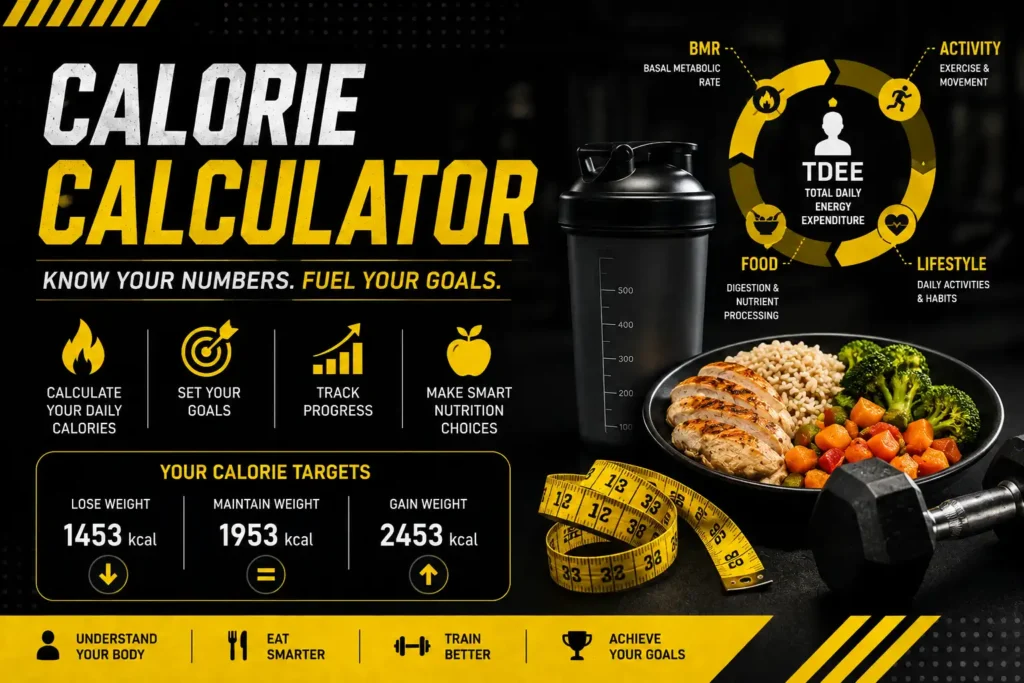
Your result is based on your Total Daily Energy Expenditure (TDEE)—the total number of calories your body burns in a typical day. Once you know this number, adjusting your calorie intake becomes much easier whether your goal is fat loss, weight maintenance, or muscle gain.
Use this calculator as the starting point for building a healthier lifestyle, improving your performance, and making informed nutrition decisions.
 Calorie Calculator
Understanding Daily Calorie Needs
A calorie is simply a unit of energy. Every activity your body performs—from breathing and circulating blood to walking, exercising, and digesting food—requires energy in the form of calories.
Even while sleeping, your body continues burning calories to keep your organs functioning and support essential biological processes. This is why everyone requires a certain number of calories every day, even if they don't exercise.
Factors That Affect Your Daily Calorie Needs
No two people burn the same number of calories each day. Even individuals of the same age and weight can have different energy requirements based on their body composition, lifestyle, and overall health. That's why using a Calorie Calculator is much more effective than relying on generic calorie recommendations or one-size-fits-all diet plans.
The HYROXS Calorie Calculator estimates your daily calorie needs by analyzing several important factors, including your age, gender, height, weight, activity level, and more. Understanding how these factors influence your metabolism can help you make smarter nutrition decisions and set realistic goals for weight loss, muscle gain, or weight maintenance.
1. Age
Age is one of the most important factors affecting your daily calorie requirements. As you get older, your metabolism naturally slows down, mainly because of changes in hormone levels and a gradual loss of lean muscle mass. This means that older adults often require fewer calories than younger individuals with similar body measurements.
Children, teenagers, and young adults generally have higher calorie needs because their bodies are still growing and developing. In contrast, adults over the age of 40 may notice that maintaining the same weight becomes more challenging if they continue eating the same number of calories they consumed in their younger years.
The Calorie Calculator automatically considers your age when estimating your Total Daily Energy Expenditure (TDEE), providing a more personalized and accurate calorie recommendation.
2. Gender
Men and women typically have different calorie requirements because of differences in body composition and hormone levels. On average, men have more lean muscle mass and lower body fat percentages than women, which means they usually burn more calories throughout the day—even while resting.
Women generally require fewer calories because they naturally have a higher percentage of essential body fat and lower muscle mass. Hormonal changes during different life stages, such as pregnancy or menopause, can also influence calorie needs.
By taking gender into account, a Calorie Calculator can generate more accurate daily calorie estimates that reflect your body's unique energy requirements.
3. Height
Your height also plays an important role in determining how many calories your body burns each day. Taller individuals usually have larger bodies, more organs, and greater overall body tissue, all of which require energy to function properly.
As a result, a taller person often burns more calories at rest than someone who is shorter, even if they weigh the same. This is why height is one of the key inputs required by the Calorie Calculator when estimating your Basal Metabolic Rate (BMR) and Total Daily Energy Expenditure (TDEE).
4. Weight
Body weight directly influences the number of calories your body needs every day. In general, heavier individuals burn more calories because it takes more energy to move a larger body and maintain normal bodily functions.
However, weight alone doesn't tell the whole story. Two people may weigh exactly the same but have very different calorie requirements depending on their muscle mass and body fat percentage. This is why the Calorie Calculator combines your weight with other important factors to provide a more accurate estimate of your daily calorie needs.
If your body weight changes significantly over time, it's a good idea to use the Calorie Calculator again to recalculate your maintenance calories and adjust your nutrition plan accordingly.
5. Muscle Mass
Lean muscle tissue is one of the biggest drivers of your metabolism. Unlike body fat, muscle is metabolically active, meaning it continues to burn calories even when you're resting. People with higher amounts of lean muscle generally have a higher Basal Metabolic Rate (BMR) and require more calories to maintain their body weight.
This is one reason why athletes and individuals who regularly perform resistance training often need more calories than people with the same height and weight but lower muscle mass.
Building muscle through strength training can gradually increase your daily calorie expenditure over time. While the increase isn't dramatic overnight, maintaining more lean muscle helps support long-term metabolic health and makes weight management easier.
6. Activity Level
Your activity level has one of the greatest impacts on your total daily calorie needs. While your Basal Metabolic Rate (BMR) represents the calories your body burns at complete rest, your Total Daily Energy Expenditure (TDEE) also includes calories burned through walking, exercise, work, household chores, and other daily activities.
Someone who spends most of the day sitting at a desk will burn significantly fewer calories than a construction worker, fitness instructor, or endurance athlete. Even simple habits like taking the stairs, walking more often, or standing throughout the day can noticeably increase your daily energy expenditure.
The HYROXS Calorie Calculator uses scientifically established activity multipliers to estimate your TDEE based on how active you are, helping you receive a more realistic calorie target for your lifestyle.
7. Hormones
Hormones help regulate many of the body's metabolic processes, including how efficiently you burn calories. Conditions affecting hormones—particularly those involving the thyroid gland—can significantly influence your metabolic rate.
For example, an underactive thyroid (hypothyroidism) may slow metabolism and reduce calorie expenditure, while an overactive thyroid (hyperthyroidism) can increase the number of calories your body burns.
Other hormones related to stress, appetite, and insulin sensitivity also affect your body's energy balance. Although a Calorie Calculator provides an excellent estimate of your calorie needs, individuals with medical conditions that affect hormone levels should consult a healthcare professional for personalized advice.
8. Genetics
Genetics also play a role in determining your metabolism. Some people naturally burn calories more efficiently or have faster resting metabolic rates than others, even when they have similar body size and activity levels.
Your genetic makeup can influence factors such as body composition, appetite regulation, fat storage, and muscle-building potential. While you cannot change your genes, healthy habits such as regular exercise, balanced nutrition, strength training, quality sleep, and stress management can help you maximize your metabolic health.
The Calorie Calculator provides an estimate based on measurable factors, but your actual calorie needs may vary slightly due to individual genetic differences. Tracking your progress over several weeks and adjusting your calorie intake based on your results is the best way to fine-tune your nutrition plan.
Why Understanding These Factors Matters
Your daily calorie needs are influenced by much more than just your body weight. Factors such as age, gender, height, weight, muscle mass, activity level, hormones, and genetics all work together to determine how many calories your body burns each day.
Instead of relying on generic calorie charts or popular diet trends, use the HYROXS Calorie Calculator to receive a personalized estimate based on your unique characteristics. Whether your goal is to lose fat, maintain your current weight, or build lean muscle, understanding these factors will help you make informed nutrition decisions and create a sustainable plan that supports long-term health and fitness.
Someone who exercises five days per week naturally burns more calories than someone with a sedentary lifestyle. Likewise, individuals with more lean muscle mass generally require more calories because muscle tissue consumes more energy than fat tissue, even while resting.
Understanding your calorie requirements allows you to create realistic nutrition plans instead of following generic diets that may not match your body's actual needs.
Calorie CalculatorHow the HYROXS Calorie Calculator Works
The HYROXS Calorie Calculator estimates your daily calorie requirements through a simple two-step process.
Step 1 – Calculate Your Basal Metabolic Rate (BMR)
First, the calculator estimates your Basal Metabolic Rate (BMR), which represents the calories your body burns while completely at rest. These calories are used to support essential functions such as breathing, circulation, hormone production, and maintaining body temperature.
The calculator uses the Mifflin-St Jeor Equation, one of the most widely accepted formulas for estimating resting calorie expenditure in healthy adults.
Step 2 – Estimate Your Total Daily Energy Expenditure (TDEE)
Your BMR is then multiplied by an activity factor based on your daily lifestyle and exercise habits. This provides your Total Daily Energy Expenditure (TDEE), which represents the total calories your body burns in an average day.
Your TDEE includes:
- Resting metabolism
- Exercise
- Walking
- Household activities
- Daily movement
- Digestion
This final value becomes the foundation for calculating calories needed for fat loss, maintenance, or muscle gain.
Calorie CalculatorBMR vs TDEE: What's the Difference?
Many people confuse BMR and TDEE, but they measure two different aspects of your metabolism.
| BMR (Basal Metabolic Rate) | TDEE (Total Daily Energy Expenditure) |
|---|---|
| Calories burned at complete rest | Total calories burned throughout the day |
| Supports basic body functions | Includes exercise and daily activities |
| Lower calorie value | Higher calorie value |
| Starting point for calorie calculations | Used to plan nutrition goals |
| Doesn't include physical activity | Includes workouts, walking, and digestion |
Think of your BMR as the minimum number of calories your body needs to survive. Your TDEE represents the actual calories you burn during a normal day.
If your goal is weight loss or muscle gain, your calorie target should be based on your TDEE, not your BMR.
Calorie CalculatorActivity Levels Explained
Choosing the correct activity level is one of the most important steps when calculating your calorie needs. Many people accidentally overestimate how active they are, resulting in calorie recommendations that are too high.
Use the descriptions below to select the activity level that best matches your lifestyle.
Calorie Calculator| Activity Level | Activity Multiplier | Description |
|---|---|---|
| Sedentary | 1.2 | Little or no exercise. Mostly sitting throughout the day. |
| Lightly Active | 1.375 | Light exercise or sports 1–3 days per week. |
| Moderately Active | 1.55 | Regular workouts or sports 3–5 days per week. |
| Very Active | 1.725 | Intense exercise 6–7 days each week or physically demanding work. |
| Extra Active | 1.9 | Professional athletes or physically demanding jobs combined with frequent training. |
If you're unsure which category fits your lifestyle, it's generally better to choose the lower activity level. You can always adjust your calorie intake later based on your progress.
Calorie CalculatorUnderstanding Your Calorie Goal
Your maintenance calories represent the amount of energy required to keep your body weight stable. From there, you can adjust your intake depending on your objective.
For Fat Loss
To reduce body fat, consume fewer calories than your TDEE. A moderate calorie deficit of 300–500 calories per day is generally considered safe and sustainable for gradual fat loss while helping preserve lean muscle mass.
Combining this approach with regular strength training and adequate protein intake can improve body composition over time.
For Weight Maintenance
If you're happy with your current weight, consuming approximately the same number of calories as your TDEE allows you to maintain your body weight while supporting everyday activities and exercise.
Maintenance calories are also useful after completing a weight-loss phase because they help stabilize metabolism and establish long-term healthy eating habits.
For Muscle Gain
Building muscle generally requires a small calorie surplus. Consuming 200–400 calories above your maintenance level, while following a structured resistance training program, provides your body with the additional energy needed to support muscle growth.
A moderate surplus is often more effective than excessive overeating because it promotes lean muscle gain while limiting unnecessary fat accumulation.
Why Calorie Tracking Matters
Many people believe they eat healthy but still struggle to achieve their goals because they underestimate how many calories they consume.
Tracking calories helps you:
- Understand your eating habits.
- Control portion sizes.
- Stay consistent with your nutrition plan.
- Monitor progress more accurately.
- Make informed adjustments when needed.
Calorie tracking doesn't have to be permanent, but it can be a valuable learning tool that helps you develop better nutritional awareness over time.
Even simple habits such as reading food labels, measuring portions, and planning meals ahead can make a significant difference in reaching your fitness goals.
Calorie CalculatorMacronutrient Distribution for Your Calories
Knowing your daily calorie target is only the first step. To get the best results, those calories should be divided between the three essential macronutrients: protein, carbohydrates, and fats. Each macronutrient serves a unique purpose and plays an important role in supporting your health, recovery, and performance. Best Macronutrient Ratio.
Calories Per Gram
| Macronutrient | Calories Per Gram | Primary Function |
|---|---|---|
| Protein | 4 Calories | Muscle repair and growth |
| Carbohydrates | 4 Calories | Energy for daily activities and exercise |
| Fat | 9 Calories | Hormone production and overall health |
A balanced intake of all three macronutrients helps your body perform at its best while supporting your specific fitness goals.
Calorie CalculatorTips for Reaching Your Calorie Goal
Knowing your daily calorie target is only the first step toward improving your health and fitness. The real challenge is consistently following your nutrition plan over time. Whether you're using the HYROXS Calorie Calculator to lose weight, maintain your current body weight, or build lean muscle, developing sustainable daily habits is the key to long-term success.
The Calorie Calculator provides a personalized estimate of your daily calorie needs, but reaching your goal depends on the choices you make every day. The following practical tips can help you stay consistent, improve your nutrition, and achieve better results.
1. Plan and Prepare Your Meals
Meal preparation is one of the easiest ways to stay within your daily calorie target. Planning your meals in advance reduces the temptation to order fast food or make unhealthy food choices when you're busy or hungry.
Preparing meals ahead of time also helps you control portion sizes and accurately track your calorie intake. Include a balance of lean protein, complex carbohydrates, healthy fats, and vegetables in each meal to support energy levels and overall nutrition.
Using the recommendations from the Calorie Calculator while planning your meals makes it much easier to stay on track and avoid accidentally eating more calories than your body needs.
2. Prioritize High-Quality Protein
Protein is one of the most important nutrients for achieving almost any fitness goal. It supports muscle repair, recovery, and growth while helping you feel full for longer periods. This can naturally reduce unnecessary snacking and make it easier to stay within your daily calorie allowance.
Aim to include a quality source of protein with every meal. Excellent options include chicken breast, turkey, fish, eggs, Greek yogurt, cottage cheese, tofu, beans, lentils, and lean cuts of beef.
If your goal is muscle gain or body recomposition, combining adequate protein intake with the calorie recommendations provided by the Calorie Calculator can help maximize lean muscle growth while minimizing excess body fat.
3. Stay Hydrated Throughout the Day
Proper hydration is essential for overall health and can also support successful weight management. Sometimes your body confuses thirst with hunger, leading you to eat when you actually need water.
Drinking water before meals may help control appetite, while staying hydrated supports digestion, nutrient transport, exercise performance, and recovery. Water also contains zero calories, making it the ideal beverage for anyone trying to manage their daily calorie intake.
Carry a reusable water bottle and drink consistently throughout the day, especially before, during, and after exercise. Combining good hydration habits with your personalized results from the Calorie Calculator can help you maintain steady progress toward your goals.
4. Get Enough Quality Sleep
Sleep plays a much bigger role in nutrition than many people realize. Adults should aim for 7–9 hours of quality sleep each night to support healthy metabolism, hormone balance, and recovery.
Poor sleep can increase hunger hormones, reduce feelings of fullness, lower energy levels, and make high-calorie foods more appealing. It may also reduce exercise performance and slow recovery from training sessions.
Getting enough sleep helps your body regulate appetite more effectively, making it easier to follow the calorie targets recommended by the Calorie Calculator and maintain healthy eating habits over the long term.
5. Exercise Regularly and Stay Active
Physical activity increases the number of calories your body burns each day and provides numerous health benefits beyond weight management. Combining regular exercise with an appropriate calorie intake creates one of the most effective strategies for improving body composition.
Include a combination of cardiovascular exercise and resistance training in your weekly routine. Cardio supports heart health and burns additional calories, while strength training helps build and preserve lean muscle mass, which can increase your overall calorie expenditure over time.
Even simple lifestyle changes—such as taking the stairs, walking more often, cycling to work, or standing instead of sitting for long periods—can contribute to your Total Daily Energy Expenditure (TDEE). Use the Calorie Calculator to estimate your daily calorie needs based on your activity level and adjust your nutrition plan as your lifestyle changes.
6. Track Your Food Intake Consistently
One of the biggest reasons people struggle to reach their calorie goals is that they underestimate how much they actually eat. Tracking your meals helps you understand your eating habits, identify hidden calories, and make more informed nutrition decisions.
You don't necessarily need to track every meal forever, but doing so for a few weeks can teach you valuable lessons about portion sizes and calorie content. Many people are surprised to discover how quickly calories from snacks, cooking oils, sugary drinks, and sauces can add up.
Using a food tracking app alongside the HYROXS Calorie Calculator allows you to compare your daily calorie intake with your personalized calorie target. This makes it much easier to stay consistent, monitor your progress, and make small adjustments whenever necessary.
Consistency Is the Key to Success
There is no perfect diet that works for everyone. The most effective nutrition plan is one that you can follow consistently over the long term. Small, sustainable habits—such as preparing meals, eating enough protein, staying hydrated, getting quality sleep, exercising regularly, and tracking your food intake—often produce better results than restrictive diets or extreme calorie cutting.
The HYROXS Calorie Calculator provides the foundation by estimating your daily calorie needs based on your unique body measurements and activity level. Combine these personalized recommendations with healthy lifestyle habits, monitor your progress regularly, and adjust your calorie intake as your goals or activity levels change. With patience and consistency, you'll be better equipped to lose fat, maintain your weight, or build lean muscle while supporting your long-term health and fitness.
Calorie CalculatorFrequently asked questions (FAQs)
What is a calorie calculator?
A calorie calculator estimates the number of calories your body needs each day based on your age, gender, height, weight, activity level, and fitness goal.
What is TDEE?
TDEE stands for Total Daily Energy Expenditure. It represents the total number of calories your body burns each day through normal body functions, daily movement, and exercise.
How accurate is the HYROXS Calorie Calculator?
The calculator provides a scientifically based estimate using the Mifflin-St Jeor Equation and activity multipliers. While individual metabolism varies, it offers an excellent starting point for planning your nutrition.
Should I eat below my BMR?
No. Your BMR represents the calories required to support essential bodily functions. Long-term calorie intake below your BMR is generally not recommended without professional supervision.
How many calories should I eat to lose weight?
Most people achieve sustainable fat loss by consuming approximately 300–500 calories below their TDEE while maintaining adequate protein intake and regular exercise.
A calorie calculator estimates the number of calories your body needs each day based on your age, gender, height, weight, activity level, and fitness goal.
TDEE stands for Total Daily Energy Expenditure. It represents the total number of calories your body burns each day through normal body functions, daily movement, and exercise.
The calculator provides a scientifically based estimate using the Mifflin-St Jeor Equation and activity multipliers. While individual metabolism varies, it offers an excellent starting point for planning your nutrition.
No. Your BMR represents the calories required to support essential bodily functions. Long-term calorie intake below your BMR is generally not recommended without professional supervision.
Most people achieve sustainable fat loss by consuming approximately 300–500 calories below their TDEE while maintaining adequate protein intake and regular exercise.